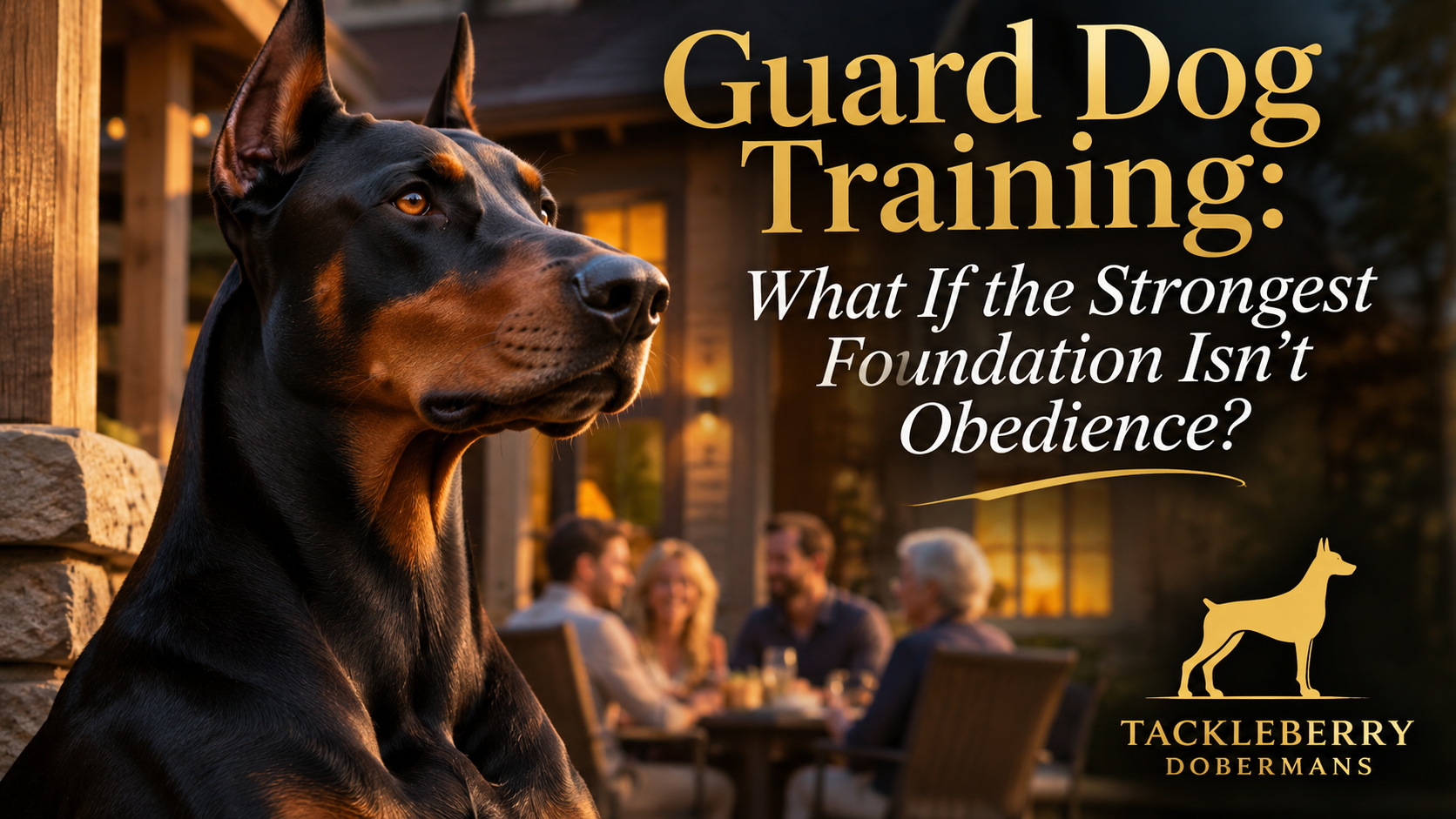

Obedience can tell your dog what to do. But what happens when doing exactly what he's told becomes the problem?
Imagine having a powerful, obedient guard dog. He's confident, capable, and trained to respond when you need him.
That's an appealing picture.
But what about the rest of your life?
You want a dog who contributes to your family's security without turning an enjoyable gathering into an exercise in managing everyone's comfort.
The friends who come over for dinner. The relatives who visit for the holidays. The neighbor who stops by unexpectedly.
And when it comes to protection, wouldn't you want confidence in what your dog can do without feeling uneasy about what he might do?
You shouldn't have to choose between feeling protected by your dog and feeling comfortable around him.
Fortunately, effective guard dog training offers more possibilities than you might realize.
Have we met?
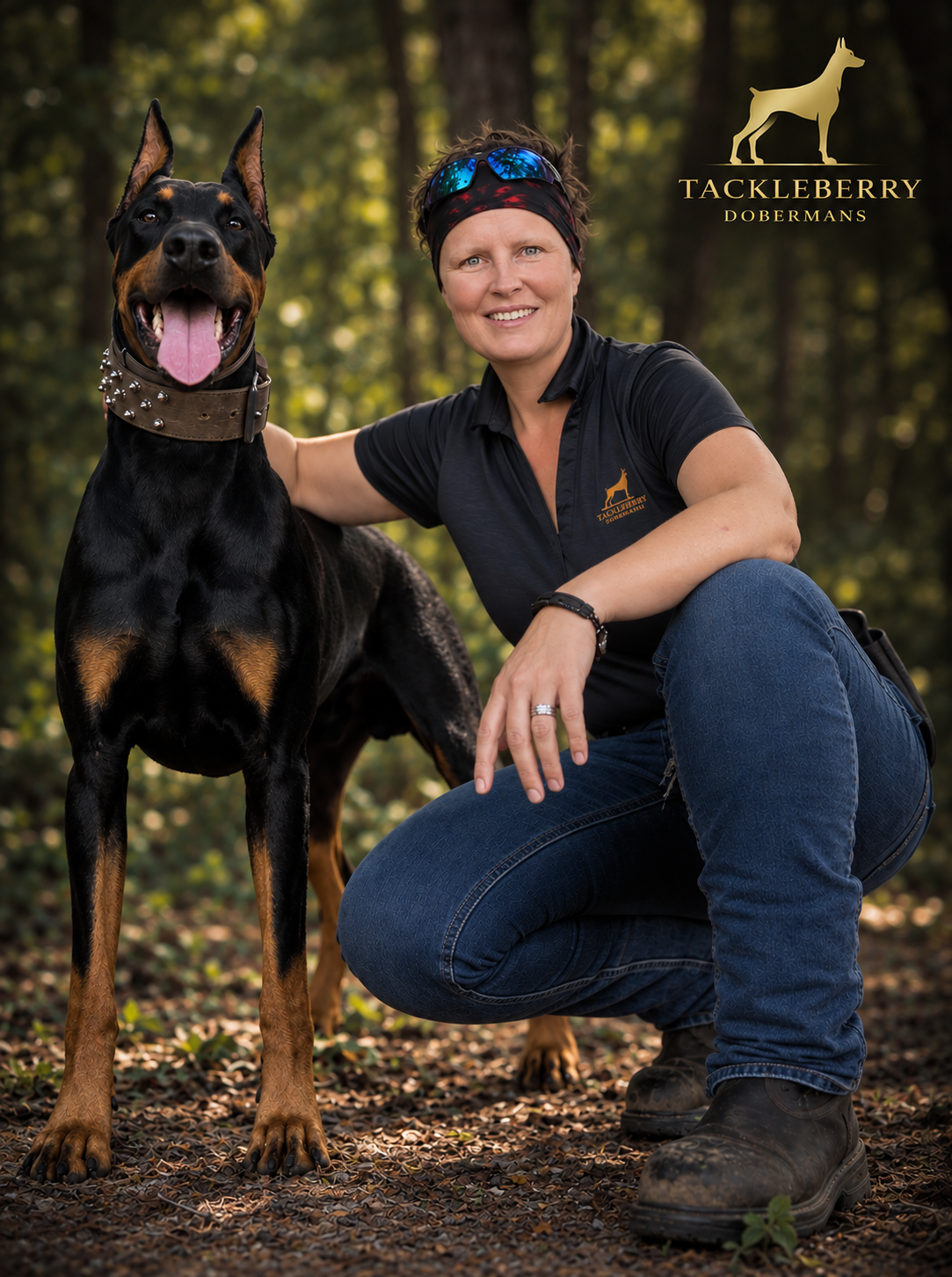
Hello, I'm Amy Arthur, founder of the Tackleberry Alliance.
My work within the K9 world is built around a simple belief: exceptional dogs deserve equally capable people beside them. Through education, development, and meaningful standards of achievement, I create practical frameworks that help you better understand the dog you're working with and discover what you're capable of accomplishing together.
Through my breeding program, the Tackleberry Alliance, and the Tackleberry Academy, you'll find the guidance, resources, and opportunities to take that partnership farther.
You bring the ambition. I'll help you build the path forward.
Guard Dog Training Should Complement Your Life, Not Complicate It
When people picture a trained guard dog, they often imagine a dog capable of confronting a threat.
There's nothing inherently wrong with that ambition. Specialized protection training can develop valuable capabilities in suitable dogs.
But physical confrontation is only one aspect of protection.
And it isn't necessarily the aspect you'll benefit from most often.
Consider the difference between a dog who treats unfamiliar people with suspicion and one who remains confident and composed around them.
Both may have an imposing presence. Both may be obedient. Yet the second dog offers an advantage that becomes especially valuable when you're welcoming guests into your home.
A good guard dog doesn't have to distrust strangers to contribute to your security.
Confidence, social neutrality, and appropriate awareness can coexist with protective capabilities.
That means your dog can enjoy the company of familiar visitors, remain composed around unfamiliar people, and still contribute to your sense of security.
The goal isn't to make your dog less capable.
It's to make his capabilities more useful to you.
And that raises an interesting question.
What if the strongest guard dog training isn't defined by how far your dog can go, but by how much of his potential you can confidently use?
Deter. Alert. Delay. Three Advantages of Effective Guard Dog Training
Protection doesn't begin and end with a physical confrontation.
In fact, some of your dog's most useful protective qualities may come into play long before a situation reaches that point.
That's the principle behind DAD: Deter. Alert. Delay.
Each capability offers a different advantage. Together, they create a broader approach to protection that can complement your lifestyle and your dog's level of training.
Deter: The Advantage of Presence
A confident dog's presence can influence how others perceive a situation.
His size, composure, attentiveness, and physical appearance may be enough to discourage unwanted attention.
He doesn't have to growl at your dinner guests or treat every unfamiliar person as an enemy to have that effect.
A dog can be approachable in ordinary circumstances and still possess a presence that makes others think twice.
That distinction gives you something valuable: the potential benefits of deterrence without making suspicion the foundation of your dog's personality.
What If Your Protection Doberman Doesn't Have to Do Anything?
Alert: The Advantage of Awareness
Your dog experiences the world differently than you do.
His hearing, sense of smell, and attention to environmental changes can provide information you might otherwise miss.
With appropriate training, that awareness can become useful communication.
An alert doesn't have to mean aggression. It can simply mean your dog has noticed something worth your attention.
And because you're part of the partnership, that information becomes an advantage you can interpret and use.
Your dog's awareness can complement your judgment rather than replace it.
Doberman Instincts: Should You Trust What Your Dog Tells You?
Delay: The Advantage of Time
Sometimes, the most valuable thing protection can provide is time.
Time to recognize what's happening. Time to make a decision. Time to respond appropriately.
Depending on the dog, the circumstances, and his training, his presence and appropriate behavior may contribute to those valuable moments.
That doesn't mean every guard dog can physically stop an attacker. Nor should an untrained dog be expected to do so.
It means protection has value beyond physical intervention.
Deter, Alert, and Delay aren't substitutes for one another. They're advantages that become more useful when understood together.
And here's where the possibilities become especially interesting.
Does a Guard Dog Always Need Bite Training to Be Effective?
No. A guard dog can provide meaningful deterrence, alerting, and other appropriate contributions to security without specialized bite training.
Bite work develops a different capability: controlled physical engagement. For suitable dogs and handlers, professional protection training may be a valuable addition.
But it isn't a requirement for every household seeking a greater sense of security.
Perhaps you want a confident, attentive dog whose presence discourages unwanted attention and whose awareness gives you useful information.
Perhaps you want those same qualities alongside advanced physical protection capabilities.
Both approaches can benefit from Deter, Alert, and Delay.
The distinction isn't between a real guard dog and an inferior one.
It's between different protective roles, each with its own capabilities, responsibilities, and limitations.
You can pursue the level of protection that fits your life without overlooking the advantages available at other levels.
And you don't have to sacrifice social confidence to pursue serious protection.
A stable dog who remains comfortable around visitors isn't demonstrating a lack of protective potential. He's demonstrating a quality that can make him considerably more enjoyable to live with.
Of course, no training framework guarantees that every dog will be suitable for protection work. Temperament, development, and professional evaluation matter, particularly when physical engagement is involved.
But the important realization remains:
You aren't limited to choosing between a friendly companion and a dog trained for confrontation.
There's a broader range of protective capabilities available to understand and develop.
Want a Dog to Feel Safer Without Aggression? What to Look For
The Most Valuable Part of Your Guard Dog's Training Might Be You
Your dog brings remarkable qualities to the partnership.
He can detect things you might miss, communicate through behavior, and respond to situations using capabilities you don't possess.
But you bring something equally important.
Judgment.
You understand your household, recognize your visitors, and know what circumstances call for your attention.
Your dog doesn't need to make every decision independently for his capabilities to be valuable.
Research into canine behavior offers an interesting perspective on this partnership. A 2013 study published in PLOS ONE found that dogs spent more time engaging in a problem-solving task when their owners were present, demonstrating what's known as the secure-base effect. Meanwhile, research into canine social referencing found that dogs may look to people for information when encountering unfamiliar situations, with their owners' emotional signals influencing their responses.
Before You Join
Occasional correspondence. Thoughtful education. Unsubscribe at any time.
Neither finding replaces the importance of training. Instead, they highlight something valuable: your relationship with your dog can influence how he experiences and responds to the world around him.
Your presence and communication can influence how your dog experiences the world.
That makes your role more than simply giving commands.
It gives you the opportunity to make better use of what your dog already brings to the partnership.
A dog who alerts you to something unusual provides information. Your judgment gives that information context.
A dog whose presence discourages unwanted attention provides deterrence. Your understanding of his temperament and behavior helps you recognize where that advantage is appropriate.
And a dog trained for advanced protection still benefits from a handler who understands his capabilities, limitations, and responsibilities.
A trained dog is an asset. A trained partnership is an advantage.
This is where obedience finds its proper place.
Obedience remains essential. Reliable responses, clear communication, and appropriate control are valuable at every level of guard dog training.
But obedience alone doesn't determine which capabilities are worth developing.
That decision begins with the kind of life you want to share with your dog.
Guard Dog Training That Fits the Life You Want
Whether you're training your own dog or considering a professional guard dog trainer, the same principle applies:
The most valuable protection is protection you can confidently and responsibly live with.
That includes a dog whose temperament suits his intended role, whose behavior remains appropriate around ordinary people, and whose training complements your household.
It also includes understanding what your dog can offer beyond obedience or physical engagement.
A dog without bite training may still provide meaningful deterrence and alerting. A professionally trained bite dog may offer those same advantages alongside specialized capabilities.
And in either case, your understanding of Deter, Alert, and Delay can help you recognize and utilize more of what your dog has to offer.
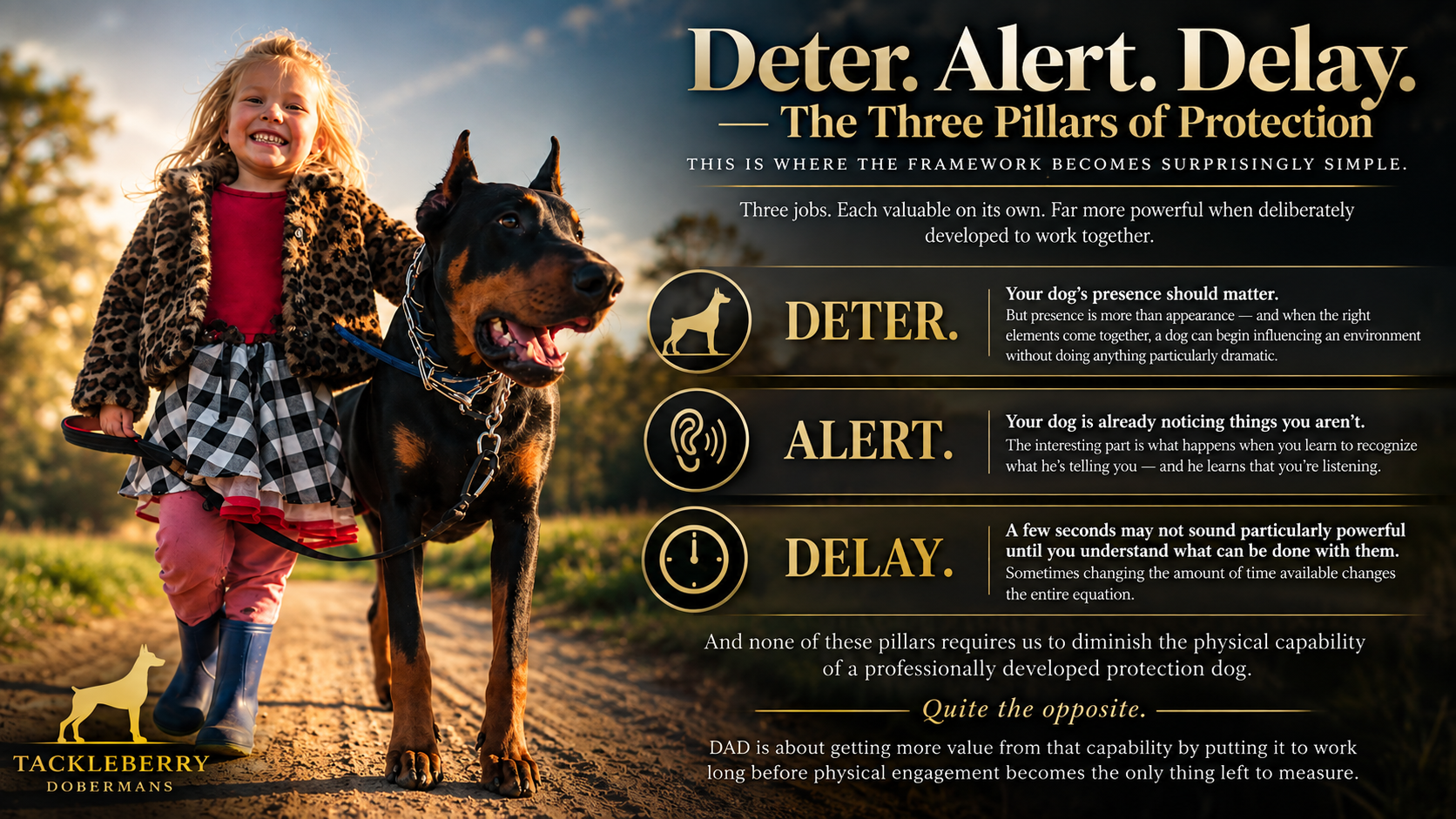
That's why the K9 DAD Academy was created.
Built around Deter. Alert. Delay., the Academy gives you a structured way to understand canine protective capabilities, strengthen communication, and develop a more effective partnership.
Whether you already have a dog, are preparing to welcome one, or intend to work with a professional trainer, the principles remain relevant.
Because the objective isn't simply to have a dog who knows what to do.
It's to have a dog whose capabilities you understand, appreciate, and can confidently use.
You wanted a dog who could help protect the life you've built. You may discover that his greatest value is how well he can become part of it.
Frequently Asked Questions About Guard Dog Training
Can a guard dog be friendly with strangers?
Yes. A well-suited guard dog can remain confident and socially neutral around unfamiliar people while still contributing to security. Suspicion toward every stranger isn't a requirement for effective deterrence or appropriate alert behavior. Temperament, socialization, and training all influence how comfortably a dog interacts with visitors.
Can a guard dog protect you without bite training?
A dog without bite training can provide deterrence through his presence, alert you to changes in his environment, and contribute to your awareness. However, those capabilities shouldn't be confused with reliable physical protection. Specialized intervention requires suitable dogs, qualified training, and responsible handling.
What's the difference between obedience training and guard dog training?
Obedience training develops reliable responses to commands and handler direction. Guard dog training may also develop appropriate awareness, alerting, deterrence, environmental confidence, and, in specialized programs, controlled physical protection. Effective programs emphasize temperament, stability, and handler control alongside the dog's intended protective role.