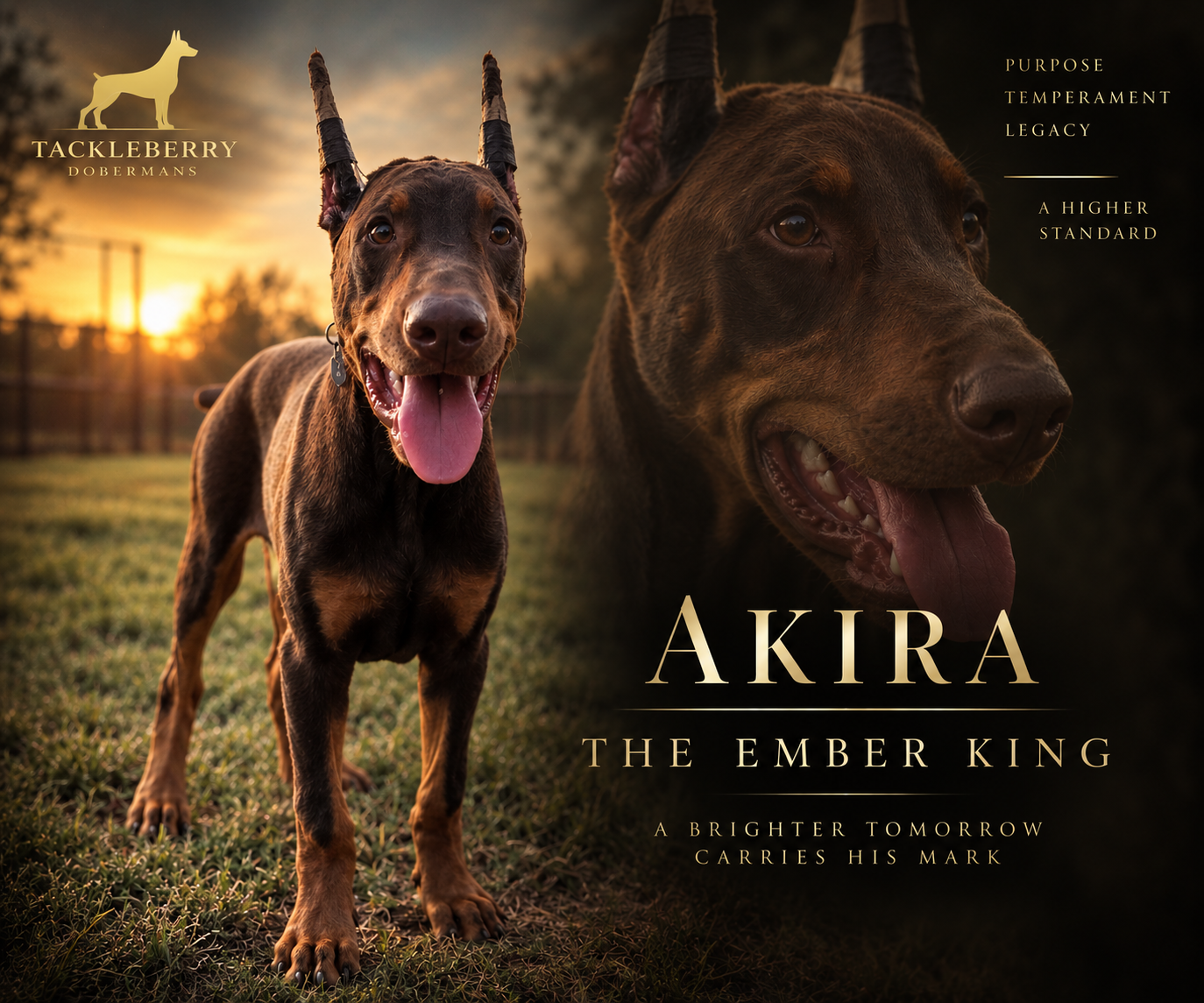

Akira - The Ember King
Guardian Class Original Tackleberry Doberman
Not Available
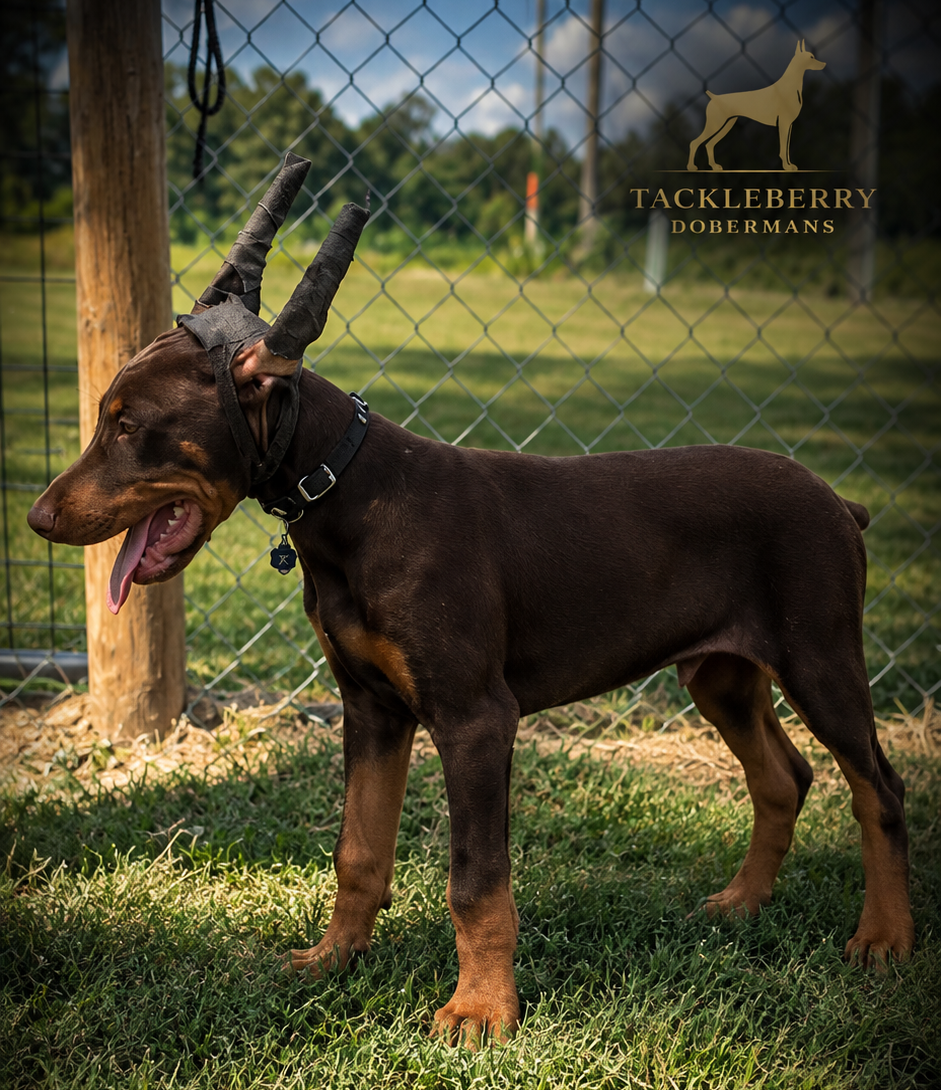
Parents: Patricia. Zeus. Birth Date: June 8, 2026. Gender: Male. Color: Red and Rust. Unique Id#: P3.2Z. Registered as an Original Tackleberry Doberman
Official Character Statement
An ember carries its fire quietly—its potential revealed by what is already within it and shaped by how carefully it is tended.
Akira, The Ember King, is a red Original Tackleberry Doberman whose earliest evaluation revealed an intriguing combination of drive, persistence, independence, playfulness, and developing environmental confidence.
His Tackleberry Passport documents more than where he began. It follows the development of those natural traits through training, experience, and eventually, life with his family.
THE EMBER KING
Akira's Tackleberry Title draws first from something impossible to overlook: his striking red coat and handsome presence.
But The Ember King means more than color.
An ember contains fire before that fire has fully revealed itself.
At seven weeks old, Akira's Legacy Evaluation gave us an early glimpse of what was already there: strong prey and object drive, persistence, independence, willingness to engage, and an active young mind. It also identified areas where thoughtful confidence development could help him grow.
That combination made The Ember King particularly fitting.
The title represents both the Doberman standing before us today and the potential that remains ahead of him.
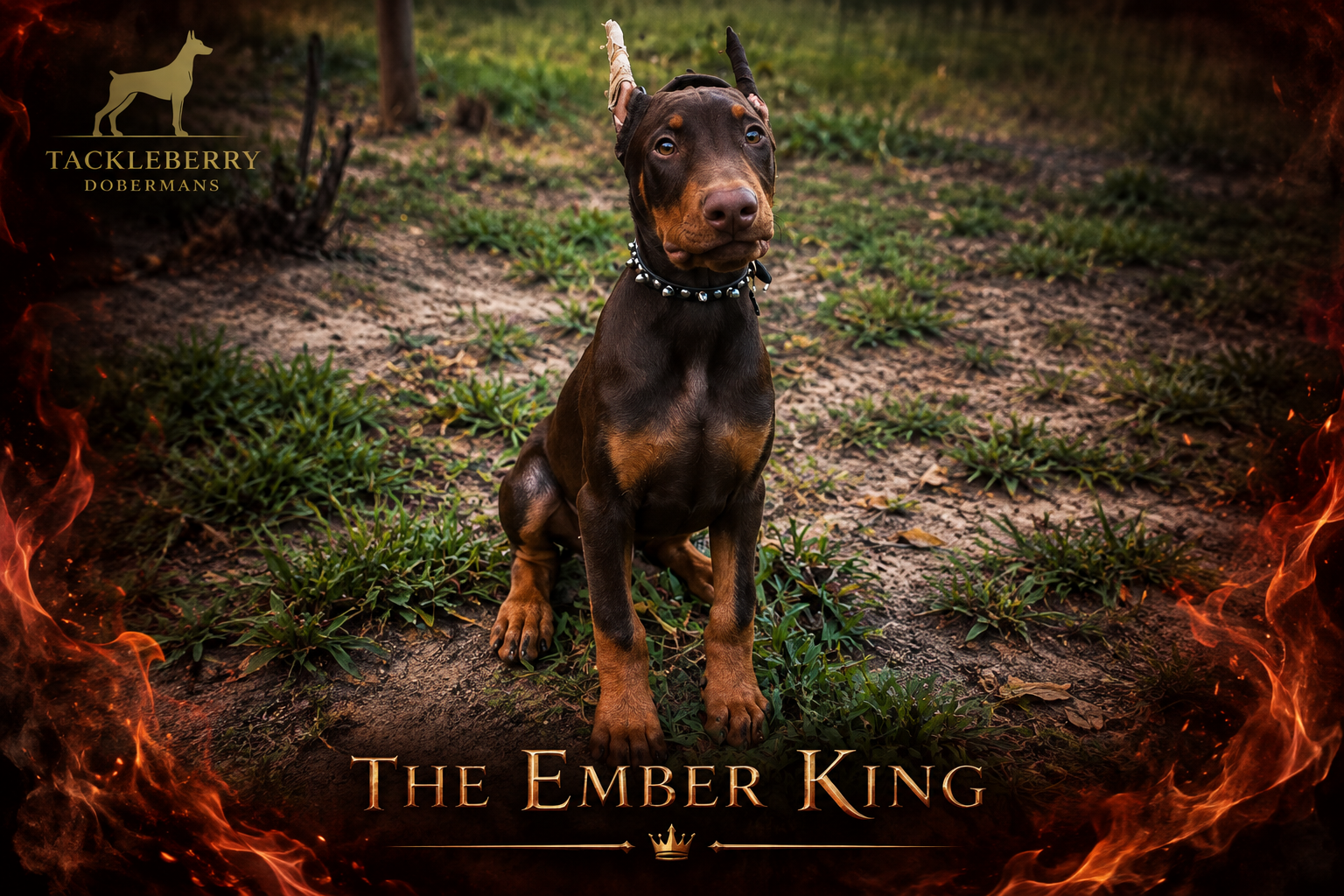
Tackleberry Temperament Evaluation
Akira's Legacy
Akira underwent his Tackleberry Legacy Evaluation on July 27, 2026, at seven weeks of age.
His final starting Legacy was declared:
 Guardian Class
The purpose of the Tackleberry Legacy Evaluation is not to predict exactly what a seven-week-old puppy will become.
It is designed to evaluate the puppy in front of us—examining natural tendencies such as social engagement, handler orientation, independence, problem-solving, object and prey drive, composure, environmental responses, and persistence. Those observations help guide development, training approach, placement considerations, and possible potential for specialized training.
Akira's overall observer impression at the conclusion of his evaluation was simple:
“Very outgoing + playful.”
Legacy Strengths
✓ Playful
✓ Persistent
✓ Quick-Learning
✓ Driven
✓ Independent
✓ Resilient
✓ Engaging
What Does a Guardian Class Doberman Mean?
Within the Tackleberry Legacy Temperament System, a starting Legacy Classification describes the behavioral direction observed during the puppy's early evaluation.
It is not a permanent prediction of adult temperament.
Akira's Guardian Class result reflected a puppy with several promising natural characteristics—including substantial prey and object drive, persistence, independence, and confident social composure—while also identifying environmental responses that warranted continued confidence development. In point, these are all attributes that are desirable for an ideal DAD doberman.
Above all, that distinction matters.
To expound, a puppy can demonstrate tremendous drive and still require confidence development. Likewise, a puppy who shows uncertainty early in life can develop considerably with maturity, appropriate socialization, training, and positive experience.
The evaluation gives us a starting point from which to develop the individual puppy.
It does not tell us where his story ends.
FROM EVALUATION TO DEVELOPMENT
Akira's evaluation influences what comes next.
Instead of treating socialization as simply exposing him to as many things as possible, his early development focused on teaching him how to experience the world.
He visited unfamiliar environments, encountered new people and dogs, explored a friend's farm, played with puppies dramatically smaller than himself, practiced leash manners in public, and learned to shift between environmental exploration and engagement with his handler.
Play became particularly useful.
Tug and other interactive games allowed us to work with Akira's natural object and prey interests rather than constantly competing against them. During public outings, play could bring his attention back to his handler, provide a positive outlet for stimulation, and reinforce the idea that engaging in training could itself be rewarding.
The objective wasn't perfectly polished puppy obedience.
It was to build confidence, engagement, curiosity, recovery, and a willingness to learn.
DEVELOPMENT IS NOT LINEAR
Akira's early development also demonstrated why a Tackleberry Passport isn't intended to freeze a puppy in time.
Following an overnight veterinary stay for his ear crop, Akira experienced some regression in his established potty-training routine, including urination in his kennel.
His response wasn't to simply push forward as though nothing had changed.
Training adapted.
At the same time, Akira entered a period in which he appeared increasingly stimulated by his surroundings—curious, exploratory, rapidly learning, but more easily distracted.
Rather than viewing that as something to rush through, we used the opportunity to continue strengthening engagement and simple problem-solving.
The priority remained the puppy developing in front of us—not an arbitrary training schedule.
WHERE AKIRA BEGINS
Akira leaves Tackleberry with considerably more life ahead of him than behind him.
His seven-week Legacy Evaluation identified the beginning.
His early training began developing it.
His family will influence what comes next.
Temperament has genetic foundations, but development continues through environment, relationships, maturity, socialization, training, and experience. Puppies may gain confidence as they grow. They may also experience temporary setbacks or become more cautious following difficult experiences—particularly during sensitive developmental periods.
That is why Akira's Guardian Class is his Starting Legacy.
His Passport will remain open to the story that follows.
Passport Record
Status
Original Tackleberry Doberman
Classification
Guardian Class
Title
The Ember King
Passport
Active
Understanding Akira's Evaluation
Can a 7-week Doberman temperament evaluation predict adult temperament?
No. Akira's evaluation documents behavioral tendencies observed at seven weeks and provides a starting point for training and development. Environment, maturity, socialization, experiences, and training can influence how those characteristics develop.
Why evaluate a Doberman puppy so young?
The purpose is to observe early natural responses before extensive training has shaped them, helping Tackleberry identify individual tendencies and make more informed decisions about development and potential training pathways.
Why was Akira classified Guardian Class if he startled at unfamiliar stimuli?
The classification considers the puppy's overall behavioral profile rather than a single response. Akira demonstrated high prey drive, strong object interest, persistence, confident social composure, independence and problem-solving ability while also identifying environmental confidence as an area for continued development.
About the Tackleberry Passport
The Tackleberry Passport serves as the official lifelong record of every Original and Registered Tackleberry Doberman.
Each Passport documents a dog's temperament evaluation, classification, achievements, developmental milestones, health records, titles, and lifelong accomplishments. Rather than remaining a static profile, every Passport grows throughout the dog's life, preserving the story of each Tackleberry Doberman for generations to come.
Siblings
Passports
Akira, The Ember King | Doberman Temperament Evaluation
Petra — The Enchantress Guardian Class Original Tackleberry Doberman Not Available Parents: Patricia. Zeus. Birth [...]
Registered Dobermans
Petra | Guardian Class Doberman Temperament Evaluation
Petra — The Enchantress Guardian Class Original Tackleberry Doberman Not Available Parents: Patricia. Zeus. Birth [...]
Registered Dobermans
Kai
Kai is a registered Doberman Pinscher under Tackleberry SolutionsNot Available Welcome to Kai's personal [...]
Registered Dobermans
Justice
Doberman puppies NC. Justice is a registered Doberman Pinscher under Tackleberry SolutionsNot Available Doberman [...]
Registered Dobermans
Duke
Doberman puppies near me: Duke is a registered Doberman Pinscher under Tackleberry SolutionsNot Available [...]
Registered Dobermans
Sadie
Sadie is a registered Doberman Pinscher under Tackleberry SolutionsNot Available Welcome to Sadie's personal [...]