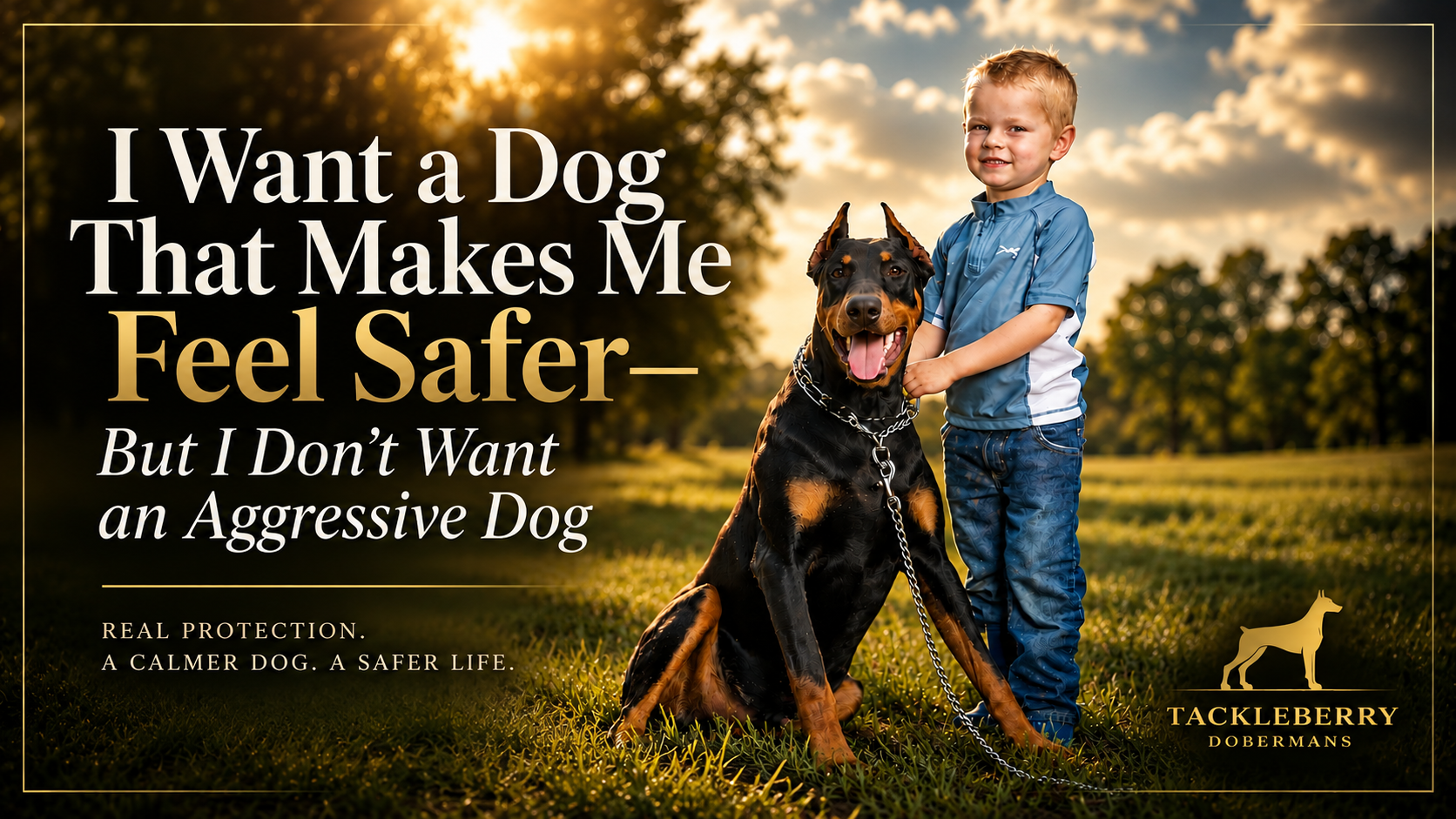

Wanting a Dog to Feel Safer Doesn't Mean You Want an Aggressive Dog
If you want a dog to help you feel safer, you may be looking for something that's surprisingly difficult to put into words. You don't necessarily want a dog looking for a confrontation. You don't want to worry about friends coming through the door, your children's friends visiting, or whether an ordinary encounter will trigger an unnecessary reaction. You want a dog that can comfortably belong in your family and live beside you in the real world.
But you also didn't start looking for a dog like this for no reason.
Maybe the house feels different when your spouse isn't home. Maybe you're more aware of noises outside at night than you'd like to be. Maybe you've caught yourself reconsidering a walk because you'd be going alone. Or maybe nothing specific has happened at all—you simply know you'd feel more comfortable with another set of eyes and ears beside you.
You want to feel less vulnerable, not introduce a new source of uncertainty into your life.
And that's where the decision can become difficult. Because when people start searching for a dog that will help them feel protected, the conversation can quickly turn toward aggression, bite work, and what a dog will do during a confrontation.
But perhaps that's starting with the wrong question.
Before asking what a dog will do once a confrontation begins, it may be worth asking what kind of dog you actually want beside you every day.
Topic: dog to feel safer without aggression
Have we met?
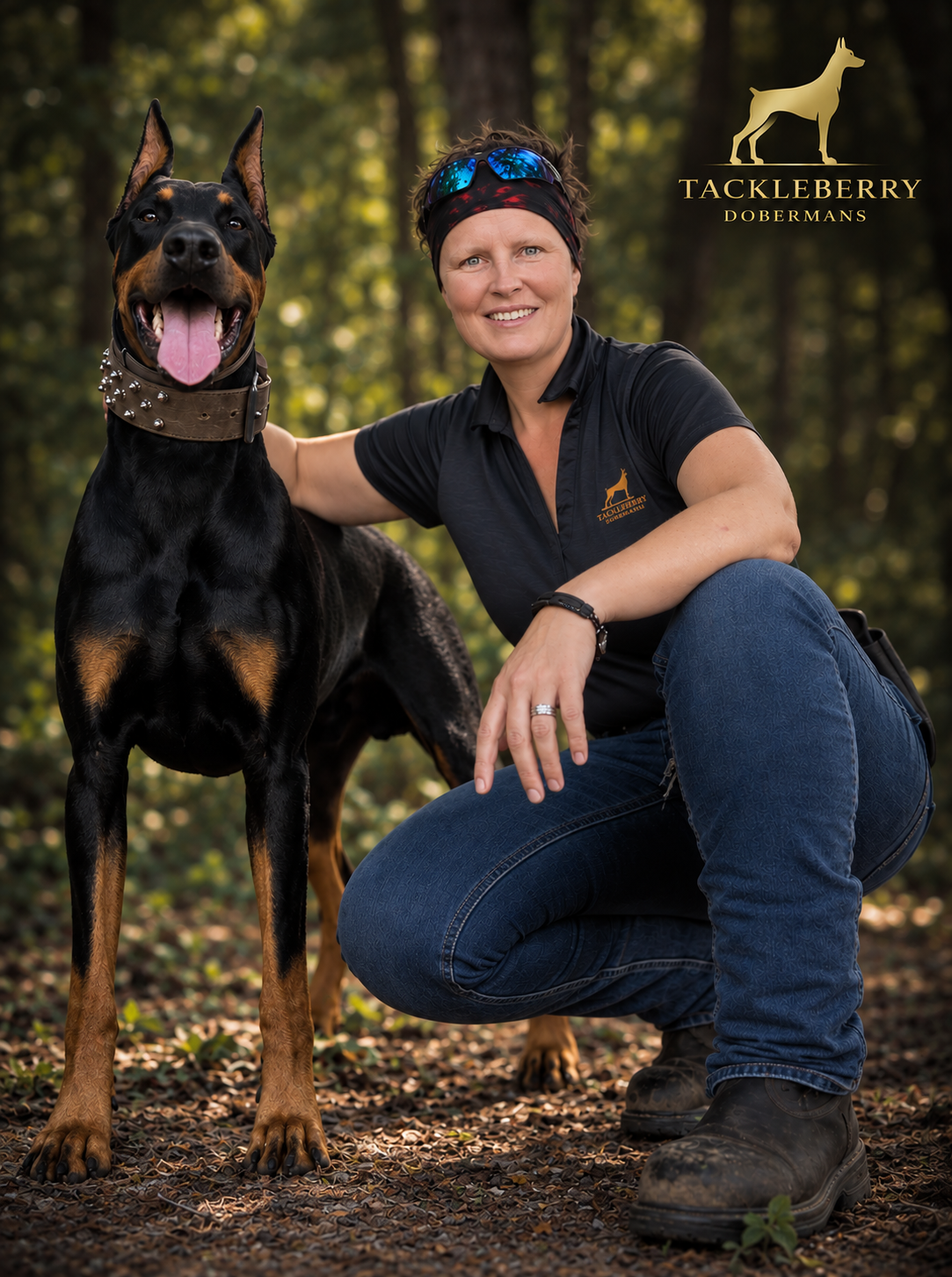
Hello, I'm Amy Arthur, founder of the Tackleberry Alliance.
My work within the K9 world is built around a simple belief: exceptional dogs deserve equally capable people beside them. Through education, development, and meaningful standards of achievement, I create practical frameworks that help you better understand the dog you're working with and discover what you're capable of accomplishing together.
Through my breeding program, the Tackleberry Alliance, and the Tackleberry Academy, you'll find the guidance, resources, and opportunities to take that partnership farther.
You bring the ambition. I'll help you build the path forward.
The Wrong Dog Can Give You a Different Reason to Feel On Edge
If your goal is to feel safer, bringing home a dog you can't confidently manage may simply trade one kind of uncertainty for another.
Instead of wondering about the noise outside, you're wondering how your dog will react when someone knocks on the door. Instead of enjoying a walk with greater confidence, you're scanning ahead for people, dogs, or situations that might trigger a reaction. Having friends over requires planning. Your children's friends need special instructions. A delivery at the door becomes an event rather than an ordinary part of the day.
The dog may look protective. He may bark harder, react faster, or make an impressive show when someone approaches. But if you're constantly managing his reactions, are you actually feeling safer—or have you simply found something new to worry about?
This is where the difference between a protective dog and an aggressive dog begins to matter.
Aggression can look powerful from a distance. Living with it is different. A dog that cannot reliably settle when nothing is wrong can make everyday life smaller: fewer visitors, fewer outings, more management, and more thought devoted to what the dog might do next.
And that isn't what you were looking for.
You wanted more freedom to enjoy your home. More confidence when you're alone. More reassurance when you're walking. You wanted the presence of your dog to reduce the amount of uncertainty in your life—not add to it.
But there's another side to this problem.
Because if you wanted nothing more than companionship, you probably wouldn't have searched for a dog to help you feel safer in the first place.
Topic: dog to feel safer without aggression
But You Don't Want a Dog That Ignores Everything, Either
You don't want to spend your life managing unnecessary reactions. But that doesn't mean you want a dog that moves through the world completely unaware of what's happening around you.
If you're home alone and hear something unusual outside, you don't necessarily want to be the first one to notice it. If someone approaches your home unexpectedly, there can be reassurance in realizing your dog noticed before you did. And when you're walking alone, part of the comfort of having a dog beside you may come from knowing that you're no longer the only one paying attention to your surroundings.
That's different from wanting aggression.
You may simply want a dog that is aware without being anxious, watchful without being reactive, and confident without looking for a reason to confront someone.
A dog that can relax while your children play, accept welcomed visitors, walk calmly through ordinary public spaces, and settle beside you at home—but doesn't seem completely disconnected from changes in the environment around him.
That's a much more complicated request than simply saying, “I want a protective dog.”
Because what you're really describing isn't a dog that's always on guard.
You're describing a dog that can be calm when life is normal and attentive when something changes.
You don't want a dog you have to worry about, and you don't want one that seems oblivious to the world around you. You want a dog whose presence gives you greater confidence—not another reason to stay on edge.
So What Are You Actually Looking for in a Dog That Helps You Feel Safer?
Probably not aggression for aggression's sake. And probably not a dog that simply looks intimidating.
Maybe the better question isn't what you want your dog to do, but how you want life to feel with that dog beside you.
Could friends and family come into your home without you worrying about an unnecessary reaction? Could you walk through your neighborhood without constantly managing the other end of the leash? Could your children enjoy the dog without the household having to organize itself around unpredictable behavior?
And at the same time, could that dog bring something more than companionship?
What if his presence itself had value?
What if a dog could be stable enough to live comfortably with your family, confident enough to provide reassurance, aware enough to notice changes around you, and controlled enough to remain responsive to you?
Then perhaps protection doesn't have to begin with asking:
What would my dog do if something happened?
Maybe there's an earlier—and potentially more important—question:
What could my dog do that might make a confrontation less likely to happen in the first place?
Topic: dog to feel safer without aggression
Further Reading: Will My Doberman Protect Me?
Can a Dog Protect You Without Being Aggressive?
Yes—but it helps to think differently about what protection can look like.
Protection is often imagined as the moment something has already gone wrong: a threat appears, a confrontation begins, and the question becomes whether the dog will physically intervene.
But by that point, an opportunity has already been lost.
The best conflict is the one that never happens.
A dog can have protective value long before anyone needs to find out what he would do in a confrontation. His presence may make someone reconsider approaching. His awareness may alert you to something you haven't noticed yet. His response may create hesitation, uncertainty, distance, or simply more time for you to make a decision.
None of those things require a dog that moves through everyday life looking for a threat.
In fact, the qualities that make a dog reassuring to live with—confidence, stability, awareness, and responsiveness to his handler—can also contribute to the very thing you were searching for in the first place: feeling less vulnerable.
That's why aggression and protection shouldn't automatically be treated as the same thing.
A dog doesn't necessarily have to create a confrontation to have an effect on one.
Sometimes, his greatest protective value may come from helping make the confrontation less likely to happen at all.
Can a Dog Protect You Without Being Aggressive?
Yes—but it helps to think differently about what protection can look like.
Protection is often imagined as the moment something has already gone wrong: a threat appears, a confrontation begins, and the question becomes whether the dog will physically intervene.
But by that point, an opportunity has already been lost.
The best conflict is the one that never happens.
A dog can have protective value long before anyone needs to find out what he would do in a confrontation. His presence may make someone reconsider approaching. His awareness may alert you to something you haven't noticed yet. His response may create hesitation, uncertainty, distance, or simply more time for you to make a decision.
None of those things require a dog that moves through everyday life looking for a threat.
In fact, the qualities that make a dog reassuring to live with—confidence, stability, awareness, and responsiveness to his handler—can also contribute to the very thing you were searching for in the first place: feeling less vulnerable.
That's why aggression and protection shouldn't automatically be treated as the same thing.
A dog doesn't necessarily have to create a confrontation to have an effect on one.
Sometimes, his greatest protective value may come from helping make the confrontation less likely to happen at all.
Topic: dog to feel safer without aggression
Further Reading: What If Your Protection Doberman Doesn't Have to Do Anything?
Protection Can Begin Before a Confrontation Ever Happens: Dog to Feel Safer Without Aggression
Think about how many decisions can happen before a confrontation ever becomes physical.
Someone may first decide whether to approach. Then whether to continue. Whether to close the distance. Whether the uncertainty in front of them is worth pushing through.
At each of those moments, there may be an opportunity for the situation to change course.
A dog can become part of those decisions without ever needing to make physical contact with anyone.
Sometimes it's simply the presence of a substantial dog beside you. Sometimes it's the sound of a dog alerting from inside the home. And sometimes it's what happens when someone continues anyway—the dog's presence or response may create hesitation, encourage greater distance, or give you more time to recognize what's happening and make a decision.
None of those things guarantee an outcome. No dog can guarantee your safety. But protection doesn't have to be all-or-nothing to have value.
The first opportunity may be discouraging an approach altogether. If that doesn't happen, noticing something sooner has value. And if someone continues anyway, creating even a little more hesitation, distance, or time can save lives.
That means the question doesn't have to begin and end with:
“Will my dog fight for me?”
There are important questions that come before it.
Could the dog's presence make someone think twice? Could the dog make you aware of something you hadn't noticed? And if someone continues despite both, could the dog create another opportunity for the situation to change course before physical contact becomes necessary?
This is where the idea of a dog for protection without aggression begins to look different.
The goal isn't to pretend that every situation can be prevented simply because a dog is present. It's to recognize that protection can have layers—and that there may be several opportunities to influence what happens before a confrontation becomes physical.
Protection can begin with the opportunity to discourage, to make you aware, and to create time when someone continues anyway.
Topic: dog to feel safer without aggression
Further Reading: Doberman Instincts: Should You Trust What Your Dog Tells You?
A Different Way to Think About Protection: Deter. Alert. Delay.
If protection can have more than one opportunity to influence what happens, then perhaps it shouldn't be measured only by what a dog might do at the final moment.
That's the thinking behind Tackleberry's 3 Pillars of Protection: Deter. Alert. Delay.
Deter comes first because the best confrontation is the one that never has to happen. A dog's presence alone may be enough to make someone reconsider approaching, choose greater distance, or decide that continuing isn't worth the uncertainty.
Alert recognizes that deterrence won't influence every situation. A dog that notices a change in the environment may give you something incredibly valuable: awareness. You may know someone is approaching the house, entering the property, or moving nearby before you would have noticed on your own.
And then there's Delay.
If someone continues despite the dog's presence and despite being noticed, the opportunity for protection hasn't disappeared. A dog's response may introduce another layer of uncertainty. It may cause hesitation. It may discourage someone from closing distance as quickly. Most importantly, it may create time—another opportunity for the situation to change course before it becomes physical.
None of these layers depends on pretending that a dog can predict human intentions or guarantee what another person will do.
And none requires a dog that spends everyday life looking for a confrontation.
Instead, Deter. Alert. Delay. asks a different question:
How much useful protection can exist before physical contact ever becomes necessary?
Because while physical intervention is often where conversations about protection begin, it doesn't have to be where your definition of protection begins.
For a family living with a dog every day, what happens in all the ordinary moments before a confrontation may matter just as much as what the dog is capable of doing in the extraordinary one.
Topic: dog to feel safer without aggression
Explore: What is a DAD Doberman?
Does a Dog Need Bite Training to Help You Feel Safer?
Not necessarily.
If the goal is greater awareness, deterrent presence, confidence, and a dog that remains responsive to you, there is meaningful development that can happen before bite work ever enters the conversation.
Professional bite development serves a different purpose. It adds another level of capability—and with it, greater responsibility, management, training, and maintenance. For some dogs and owners, that's an appropriate destination. For others, it may be more than they actually need.
That's why the question isn't whether bite training is good or bad. It's whether it belongs in the answer to the problem you're trying to solve.
And that's also why Tackleberry doesn't teach every owner toward the same destination.
Further Reading: What Is the DAD Standard?
Topic: dog to feel safer without aggression
So How Do You Build This Kind of Dog?
Understanding what you want from your dog is one thing.
Developing it intentionally is another.
A dog doesn't become calm in ordinary situations, confident in unfamiliar environments, responsive to his handler, and appropriately aware of what's happening around him simply because he's a protective breed.
Those qualities are shaped by what you practice every day.
What do you encourage when your dog notices something unfamiliar? When should an alert be acknowledged—and when should the dog settle again? How do you build confidence without creating unnecessary suspicion? How do you strengthen obedience without teaching a dog to simply move through the world waiting for instructions?
And perhaps most importantly: how do you know which protection skills actually belong in the life you want to live with your dog?
You don't need hundreds of disconnected techniques.
You need a clear framework for developing the right qualities, in the right order, for the level of protection you're actually trying to achieve.
That's why Tackleberry created The DAD Academy.
The Academy takes the principles behind Deter. Alert. Delay. and turns them into a practical, step-by-step path you can work through with your own dog.
But not every owner is trying to reach the same destination.
Some families want the confidence, obedience, environmental stability, awareness, and deterrent presence of a capable dog—without taking on professional bite development.
Others intentionally want to develop beyond that foundation into professional protection work and understand the additional responsibility that comes with it.
The DAD Academy provides a path for both.
Topic: dog to feel safer without aggression
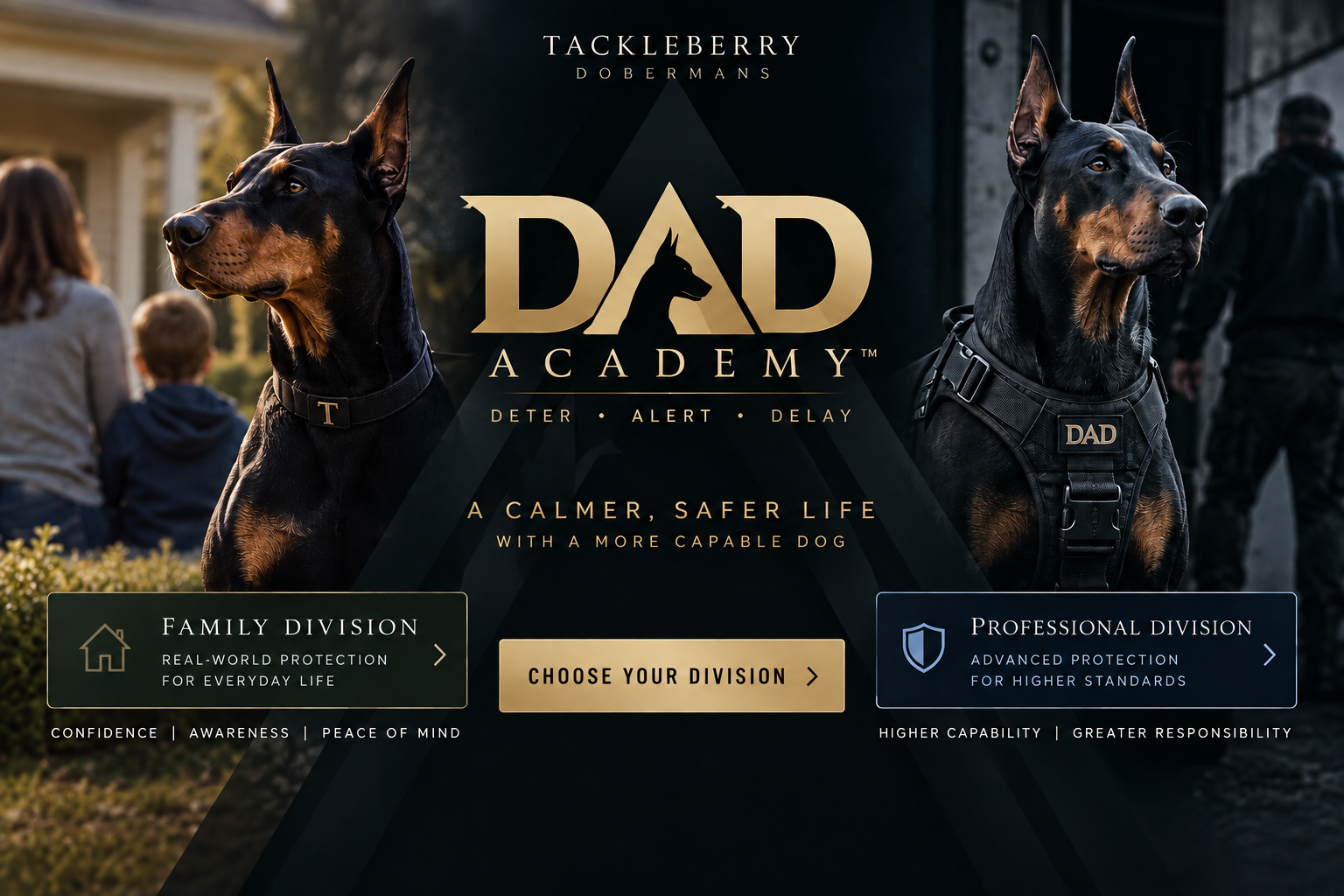
DAD Family Division
The DAD Family Division is built for the owner who wants meaningful protective value without making professional bite development the goal.
The focus is on developing a stable dog you can confidently live with every day while intentionally building the qualities behind Deter. Alert. Delay.
The objective isn't to create more confrontation.
It's to develop a dog whose confidence, presence, awareness, obedience, and relationship with you can help create more opportunities to avoid it.
DAD Professional Division
For owners intentionally pursuing professional protection development, the DAD Professional Division builds beyond that foundation.
Professional bite development introduces capabilities that require a higher standard of handling, management, maintenance, and responsibility. The Professional Division is designed for owners prepared to take on that additional standard rather than treating bite work as the automatic next step for every protective dog.
Different destination. Higher responsibility.
But the foundation still matters.
Which Kind of Protection Are You Actually Looking For?
You started this article with what may have felt like a contradiction:
I want a dog that helps me feel safer—but I don't want an aggressive dog.
It doesn't have to be a contradiction.
Protection doesn't have to begin with confrontation.
It can begin with a dog that makes someone reconsider approaching.
A dog that notices.
A dog that gives you time.
A dog that can be calm when nothing is wrong, without being absent when something is.
That's the idea behind Deter. Alert. Delay.
And now the question isn't whether your dog needs to become more aggressive.
It's how far you want to develop the dog beside you.
Choose the division that matches the kind of protection you actually want to build.