

You’ve Done the Things You Were Supposed to Do
You lock the doors. You pay attention. You may already have cameras, an alarm, or other precautions in place.
So why don’t you feel completely safe in your home?
Maybe you barely think about it when another adult is there. But when you’re the only adult home—especially at night—something changes.
Nothing has to be wrong.
You’re just the one who has to notice if it is.
You already know you're reading this on a Doberman website.
So it would be easy to assume where this is going.
But simply adding a Doberman—even a professionally trained one—to your home isn't the answer.
Have we met?
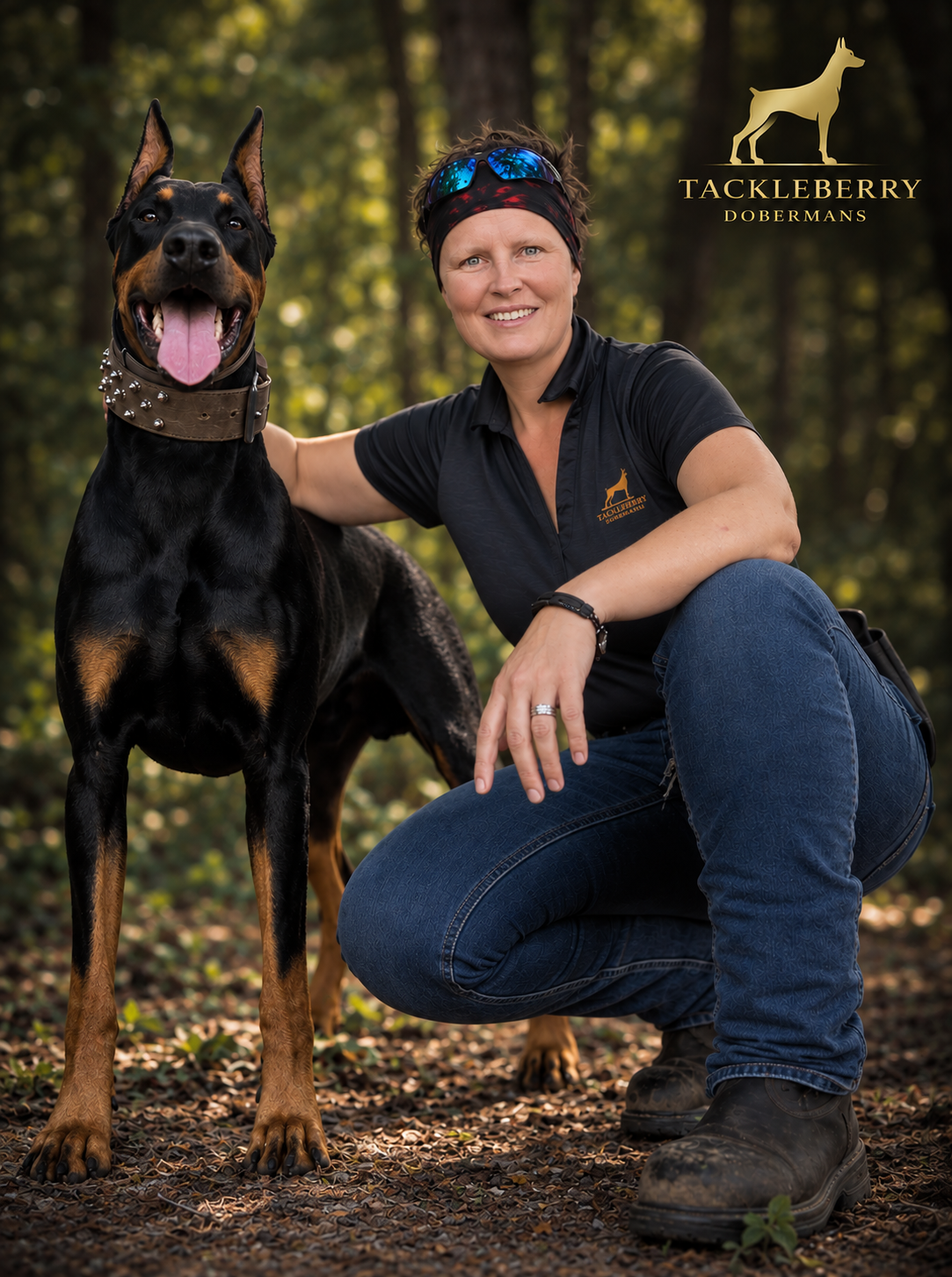
Hello, I'm Amy Arthur, founder of the Tackleberry Alliance.
My work within the K9 world is built around a simple belief: exceptional dogs deserve equally capable people beside them. Through education, development, and meaningful standards of achievement, I create practical frameworks that help you better understand the dog you're working with and discover what you're capable of accomplishing together.
Through my breeding program, the Tackleberry Alliance, and the Tackleberry Academy, you'll find the guidance, resources, and opportunities to take that partnership farther.
You bring the ambition. I'll help you build the path forward.
There’s a Reason You’re Still Paying Attention
You don't always need to be able to explain a feeling immediately for it to be worth examining.
Your brain is constantly processing more information than you actively notice. In fact, research into intuition suggests that what we call a “gut feeling” can sometimes emerge from cues and patterns we've registered before we've consciously worked out what they mean.
That doesn't mean every uneasy feeling is a warning.
You're not necessarily afraid. You're paying attention.
And if part of you keeps returning to the feeling that something is missing, perhaps the most useful response isn't to argue yourself out of it.
It's to get curious about what the feeling is pointing toward.
What If the Answer Isn't Another Precaution?
Once you start looking for what's missing, the obvious answer is to add something else.
A dog could be part of the solution. But if you're looking for a dog that helps you feel safer without introducing unnecessary aggression, that presents its own set of questions.
That's why simply bringing home a Doberman—even a professionally trained one—was never the complete answer.
Not to mention, professionally developed protection dogs can represent a substantial investment. In fact, it isn't unusual for a finished protection dog to cost tens of thousands of dollars—and exceptional dogs can command considerably more.
For the right owner, that may be exactly the right investment. But if simply adding a dog isn't the answer—and purchasing a finished one isn't necessarily the answer either—what exactly is?
Few Realize this, but Security Doesn't Begin When Something Goes Wrong
Most conversations about security eventually arrive at the same moment:
Something has already happened.
Someone has approached. Something has been noticed. A situation has become threatening. Now what?
But there's an entire part of security that happens before that moment ever arrives.
To start, an unwanted intent can be prevented before an approach is ever on the table.
Something unusual can become apparent before it reaches your door.
A few additional life-saving moments can change what you're able to do if a situation continues developing.
None of those outcomes requires defeating anything.
They change the conditions under which you have to deal with it.
And that distinction matters when what you really want isn't a dramatic response.
You want to feel more secure in your own home.
Perhaps, then, the most useful question isn't only:
“What will protect me if something happens?”
It's:
“What could change whether—and how—I ever have to face that moment at all?”
Three Advantages That Can Change the Situation
There’s a seductive weakness in how we tend to imagine protection: the more completely it removes us from the equation, the better it must be.
But anything that depends on you never having to respond has a weakness built into it.
No dog, technology, or system can guarantee what happens next.
Deter. Alert. Delay. doesn't have to.
The advantage isn't knowing what happens next. It's having more working in your favor when it does.
Consider these three pillar advantages.
1. Deterrence: Not every potential threat becomes an actual encounter. Sometimes, a threat decides your home—or you—simply isn't worth the risk.
You may never know they considered you in the first place.
Nothing had to happen for something important to have happened: a decision changed.
2. Alert: There are two frustrating extremes. At one end, you have no warning at all. You become aware of something only when it's already too close. At the other, you have so many notifications, sounds, and routine alerts that you're constantly deciding which ones actually mean something.
Or worse, you start ignoring them all for the sake of sanity.
The advantage is somewhere between the two: becoming aware of something unusual early enough for the information to still be useful.
Knowing sooner gives you more choices about what happens next.
3. Delay: Sometimes, a situation continues despite the first two advantages.
That's when even a small amount of additional time can matter.
Because there’s a difference between circumstances deciding for you—and having enough notice to still have a say.
But Where Do Those Advantages Come From?
Deter. Alert. Delay. may sound simple enough on paper.
The harder question is:
How do you actually create those advantages in everyday life?
Perhaps the answer isn't something new at all.
Perhaps it's something whose value we've learned to think about in entirely the wrong way.
Because those advantages don't matter only in theory—or in the dramatic moment when everything has already gone wrong. They matter in the ordinary decisions, routines, and circumstances that determine how much notice, time, and choice you have.
That's where DAD protection becomes personal.
Not by assuming you need a different dog—or even that you have one yet.
But by looking differently at what can create an advantage for you.
What deserves your attention? What could change an encounter before it begins? What gives you more time, more information, or more say when circumstances are uncertain? How is this possible without going too far in the other direction?
- How can you deter a threat without making your home seem unwelcoming to friends or neighbors?
- How can you be alerted to something that may need your attention without too much or too little feedback?
- What could possibly delay an unwelcome visitor without making everyday life difficult?
DAD gives those questions a framework. The Academy helps you begin answering them.
This is Where a Whole New World Unfolds
Once you stop looking at protection as a single skill or a single moment, far more becomes possible.
And remarkably, much of it doesn't require anything extraordinary.
A useful DAD doesn't appear simply because you own the right dog.
But neither does developing one require you to become a professional dog trainer.
There's a considerable amount of ground between “just own the dog” and “leave it to the professionals.”
That's the ground The Tackleberry Academy was created to explore.
There are hundreds of ways to train a dog. DAD isn't about collecting them.
Deter. Alert. Delay. brings seemingly ordinary elements together around a larger purpose.
Individually, none of them may sound particularly remarkable.
But together, they can become something far more powerful.
That's the sophistication of DAD.
It isn't in making things complicated. It's in bringing the right elements together so that what seems simple can offer you far more than you might expect.
The Starting Point May Surprise You
You don't need to already own a Doberman to begin.
In fact, DAD can begin well before there is a dog beside you.
It begins with understanding the role.
And if you haven't chosen your Doberman yet, there's an advantage in that: you can understand what you're looking for before you start looking.
For some, that understanding may shape the dog they eventually choose. For others, it may change the way they look at the Doberman already in their life.
Either way, the Academy starts in the same place:
Not with a list of commands, but with a clearer understanding of what you're trying to accomplish.
From there, the pieces begin to make considerably more sense.
Curious?
See where DAD leads.
The next step is yours.
Enrollment reserves your place in the DAD Family Division.
To protect the quality of the DAD Academy experience, new members enter after a waiting period. From there, access is earned progressively rather than handed over all at once.
Going further is an investment.