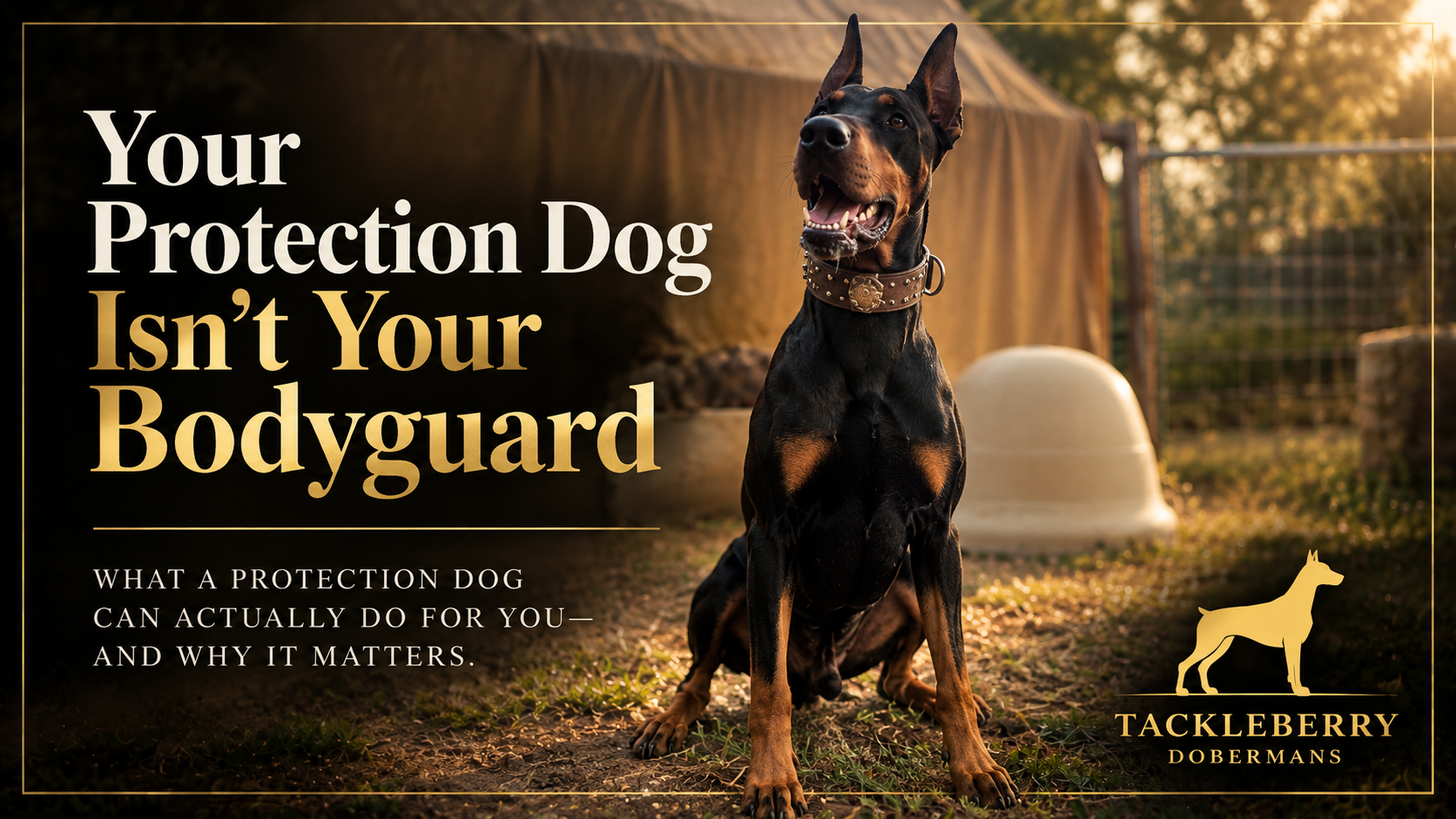

Even a $100,000 protection dog still expects you to participate. Rude, perhaps. But remarkably useful once you understand why.
Because when most people picture the moment their protection dog finally earns his keep, they're probably not imagining themselves doing very much.
Something happens.
The dog recognizes the threat.
The dog intervenes.
You’re protected.
Clean. Simple. Reassuring.
And perhaps a little too convenient.
Because somewhere along the way, we took an animal capable of giving us an extraordinary advantage and quietly handed him the entire job.
Have we met?
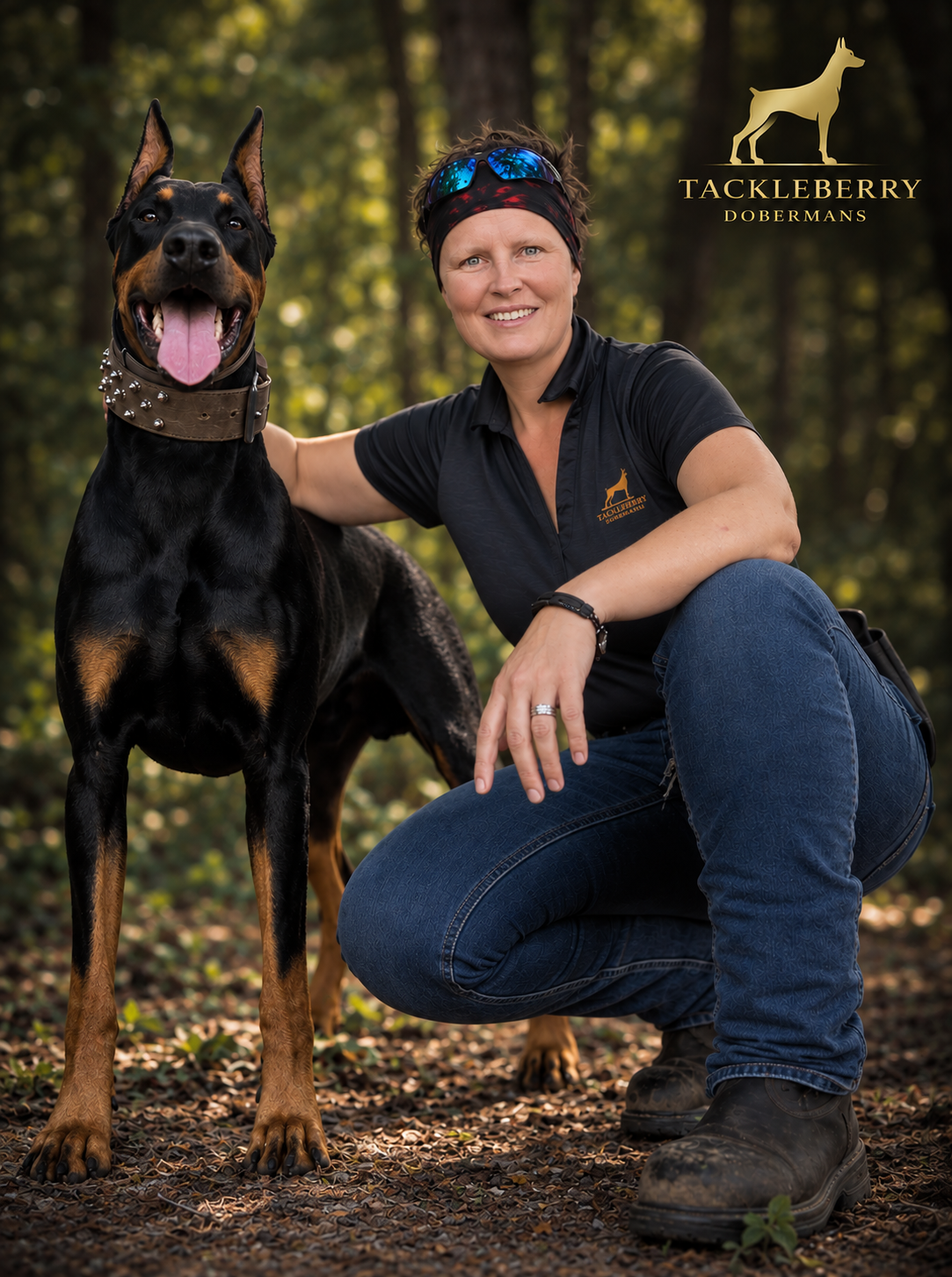
Hello, I'm Amy Arthur, founder of the Tackleberry Alliance.
My work within the K9 world is built around a simple belief: exceptional dogs deserve equally capable people beside them. Through education, development, and meaningful standards of achievement, I create practical frameworks that help you better understand the dog you're working with and discover what you're capable of accomplishing together.
Through my breeding program, the Tackleberry Alliance, and the Tackleberry Academy, you'll find the guidance, resources, and opportunities to take that partnership farther.
You bring the ambition. I'll help you build the path forward.
What Is a Protection Dog Actually Supposed to Do?
Obviously, your answer is right there in the name: protect.
Fair enough.
But protect is a much bigger job than fight.
Long before physical intervention becomes necessary, a well-developed protection dog can actually begin changing the conditions around you. His presence alone may influence whether someone chooses to approach—but presence is more than size, muscle, or an intimidating silhouette.
There is a difference between a large dog who happens to be standing beside you and a dog who moves through the world with confidence, composure, and awareness. That difference isn't created by the dog's training alone. It develops through the framework connecting a strong foundation in the dog with a handler who understands how to recognize, direct, and reinforce what that dog brings to the partnership.
In other words, effective deterrence doesn't require a dog to manufacture aggression. Quite the opposite: a dog who appears comfortable, controlled, and difficult to unsettle can communicate quite a lot without making a scene.
Meanwhile, his value isn't limited to what someone else sees. His awareness may catch a change you haven't noticed yet, while subtle changes in his own behavior can give you information about what's happening around you. As a result, you may gain something extraordinarily valuable before an encounter ever becomes physical: time to notice, evaluate, and respond.
None of this makes physical capability unimportant. For a professionally trained protection dog, that capability may be very real, and there are circumstances where it matters. However, it shouldn't be the only moment that counts.
If we judge a protection dog primarily by what happens after a situation has already escalated into physical conflict, we overlook much of what made having that dog valuable in the first place.
So perhaps the better question isn't simply:
“Will my protection dog fight for me?”
It's:
“Your protection dog should carry enough power that his presence alone can impact the world around you.”
Because sometimes the dog who does his job best never has to get the dramatic moment people imagined when they bought him.
And that brings us to an uncomfortable little truth:
The Most Dramatic Outcome Isn’t Always the Best One
There is something undeniably impressive about watching a highly trained protection dog work. The speed, commitment, control, and sheer physical capability can make the final moment look like the defining measure of the dog.
But the bite is easy to notice.
The advantage created before it is much easier to overlook.
A capable protection dog can begin affecting an encounter before most people would even recognize that an encounter has begun. His presence may alter someone’s approach. His awareness may pick up a change before yours does. A subtle shift in his behavior may draw your attention toward something you would otherwise have missed.
None of those moments look particularly dramatic.
Yet each one can change what happens next.
That is where protection becomes more interesting than simply asking whether the dog is willing to engage. The question becomes how much useful influence the dog can bring into the situation—and how early that influence begins.
Because physical capability is powerful.
But a protection dog whose capability only becomes useful at the moment of physical engagement is leaving an extraordinary amount of power on the table.
The dramatic moment may be the easiest one to see. It isn't necessarily the moment that gave you the greatest advantage.
And that difference becomes especially important when we make the dog responsible for the entire plan.
Further Reading: Will My Doberman Protect Me?
What Happens When the Dog Becomes the Entire Plan?
There is a strange contradiction in expecting more from a protection dog while quietly expecting less from ourselves.
The better trained the dog becomes, the easier it can be to imagine that our responsibility shrinks. He has the genetics. He has the training. He has the physical capability. So when something goes wrong, surely his job is to take it from there.
No matter how extraordinary your protection dog becomes, however, he's still not going to wrap up your conflict, put a pretty bow on it, and neatly set it on the curb for removal.
He can be exceptionally trained. Exceptionally powerful. Fast, confident, perceptive, controlled, and capable of things you simply cannot do yourself. That's precisely why he's such an extraordinary asset.
But an asset becomes far more powerful when you know how to use what it gives you.
Your protection dog can notice what you haven't noticed yet. His presence can influence the environment before you ever need to respond to it. He can alert you, create hesitation, buy time, and—when professionally developed—bring serious physical capability to the equation.
None of that makes you less important. It makes you more capable.
That's where the bodyguard expectation begins leaving capability on the table. If the plan is simply wait until something goes wrong and let the dog handle it, then one of the most valuable parts of the equation—the relationship between what the dog perceives and what the handler understands—has barely been developed.
A protection dog becomes far more useful when his awareness can sharpen yours, his presence can influence the environment around you, and his behavior can communicate information that helps you make better decisions. Likewise, your ability to understand and direct him gives all of that capability somewhere intelligent to go.
This isn't about asking less from the dog.
It's about expecting more from the partnership.
Because the real advantage isn't having a powerful dog standing between you and the world.
It's learning how to develop a relationship in which his capability and your judgment strengthen one another—until what you can accomplish together becomes greater than what either of you brought to the partnership alone.
And once you look at protection that way, the dog's job begins to change.
A Protection Dog Should Change What’s Possible for You
That is where the value of a protection dog becomes much bigger than having someone—or something—capable of stepping into a fight.
The right dog should change what is possible for you before, during, and after an encounter.
Put the right pieces together, in the right order, with enough consistency, and something begins to change. He can become an extension of your awareness beyond what you can see and hear on your own. His presence can influence how others behave around you. His communication can give you information sooner. And his physical capability can become part of how you navigate the world together.
But perhaps most importantly, he can give you time.
Time to notice.
Time to think.
Time to make a decision while you still have choices.
And when seconds matter, even a small advantage can radically change what happens next.
This is why I don't think of a protection dog as a four-legged bodyguard whose job begins when yours becomes difficult. I think of him as something far more valuable: a force multiplier.
He doesn't replace your ability to protect yourself.
He expands it.
It is also the idea behind a very simple framework:
Learn More: What is a DAD Doberman?
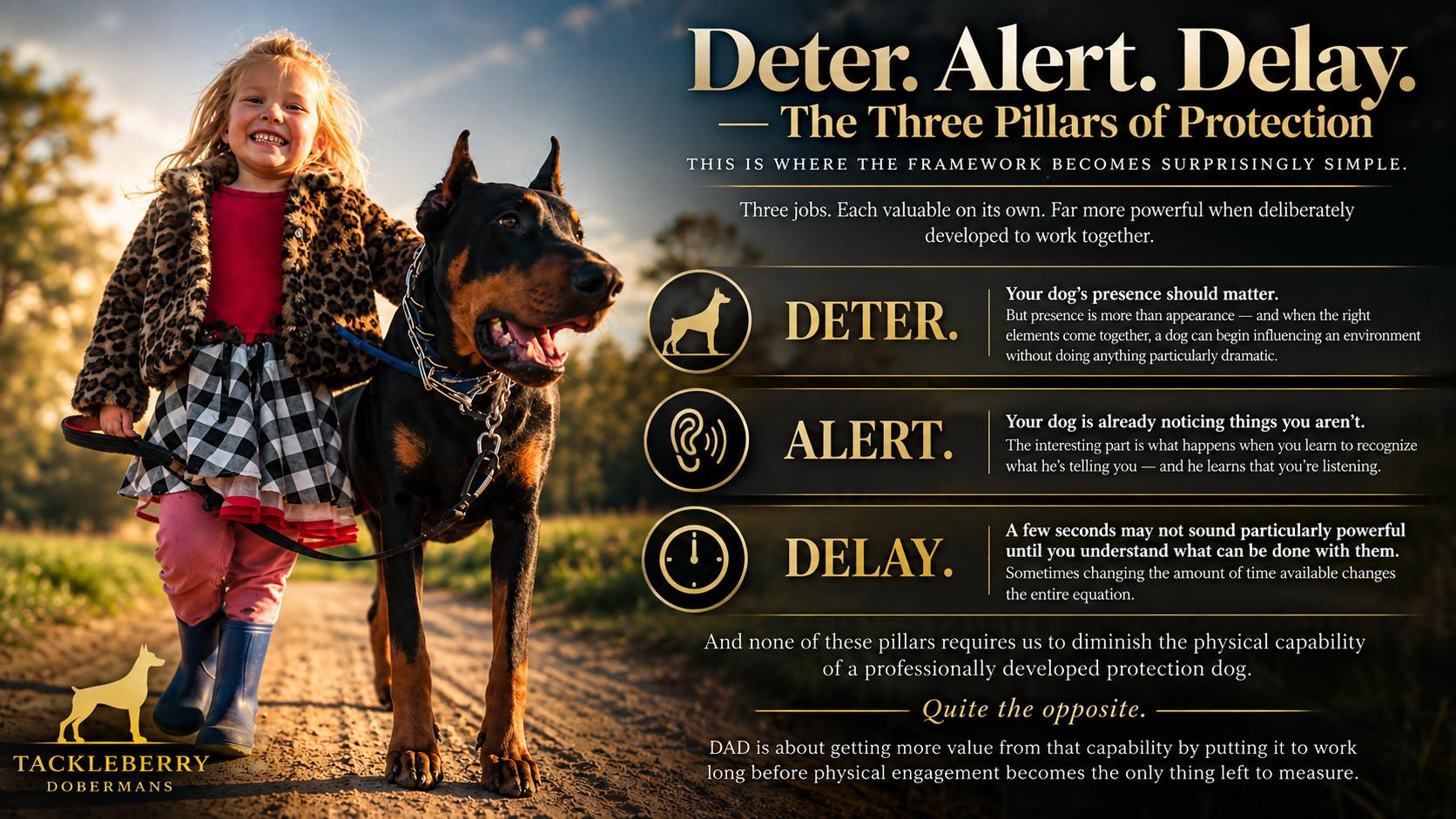
Deter. Alert. Delay. — The Three Pillars of Protection
This is where the framework becomes surprisingly simple.
Deter. Alert. Delay.
Three jobs. Each valuable on its own. Far more powerful when deliberately developed to work together.
Deter. Your dog’s presence should matter. But presence is more than appearance—and when the right elements come together, a dog can begin influencing an environment without doing anything particularly dramatic.
Alert. Your dog is already noticing things you aren’t. The interesting part is what happens when you learn to recognize what he’s telling you—and he learns that you’re listening.
Delay. A few seconds may not sound particularly powerful until you understand what can be done with them. Sometimes changing the amount of time available changes the entire equation.
And none of these pillars requires us to diminish the physical capability of a professionally developed protection dog.
Quite the opposite.
DAD is about getting more value from that capability by putting it to work long before physical engagement becomes the only thing left to measure.
Three pillars sound simple.
Learning to make them work together is where things get interesting.
Related: What Is the DAD Standard?
Simple Doesn’t Mean Easy
Three words are easy to remember.
Deter. Alert. Delay.
But knowing the words and developing a dog-handler team capable of putting them to work are two very different things.
The difference lives in the details: what you reinforce, what you overlook, when you intervene, when you allow the dog to think, how consistently you communicate, and whether the individual pieces are being developed in an order that allows them to strengthen one another.
Get those pieces working together and something interesting begins to happen.
The dog becomes more capable because the handler becomes more capable. The handler becomes more effective because she understands how to recognize and use more of what the dog is already bringing to the partnership.
And eventually, what looked like three remarkably simple ideas begins to function as one system.
That is also why DAD isn't about collecting hundreds of techniques.
You don't need hundreds of techniques. You need the right ones, practiced consistently, and assembled in a way that makes each one more valuable than it would have been alone.
Which raises an interesting question:
How much is your protection dog already giving you that you haven't learned to use yet?
The Dog Is Only Half the System
You can invest in exceptional genetics, professional training, and serious physical capability.
But eventually, the leash ends up in your hand.
And that changes the equation.
Because the goal isn't simply to own an extraordinarily capable protection dog. It's to become capable of operating with one.
That requires something different from knowing his commands or successfully completing a handoff with his trainer. The relationship has to continue developing after the professional training ends—and the handler has to develop along with it.
This is where much of the untapped potential lives.
The dog brings capability. The right relationship gives you access to more of it—more awareness, more influence, more options, and ultimately more control over what happens around you. Over time, the two stop functioning like an owner managing a highly trained animal and begin developing into something much more interesting:
a team whose effectiveness comes from the relationship between them.
That's the part you can't purchase already assembled.
And it's exactly the part we built the DAD Professional Division to develop.
You Already Know What You Want. Let’s Make It More Valuable.
If you're going to bring this level of capability into your life, why settle for using only part of it?
Whether you're choosing your first protection dog, developing one now, or already living with a professionally trained dog, the bigger opportunity is the same:
Deter. Alert. Delay. is the framework.
Now see what becomes possible when you tap into the parts of a protection dog most people never think to use.