
If you invest thousands of dollars in professional Doberman training, what should you reasonably expect when your dog comes home?
Six weeks of professional Doberman training can accomplish a lot. But the hardest part often begins when the dog comes home.
The dog knows what she's learned. The trainer has seen what she can do. But now the handler, environment, routines and expectations all change.
That's the transfer—and it's one of the most important things to understand before investing in professional training.
It's also what a dissatisfied client taught me about improving my own program.
So when I recently received my first one-star review, the important question wasn't how to defend six weeks of work.
It was a better question:
What should six weeks of Doberman training actually accomplish—and what can't it do?
Have we met?
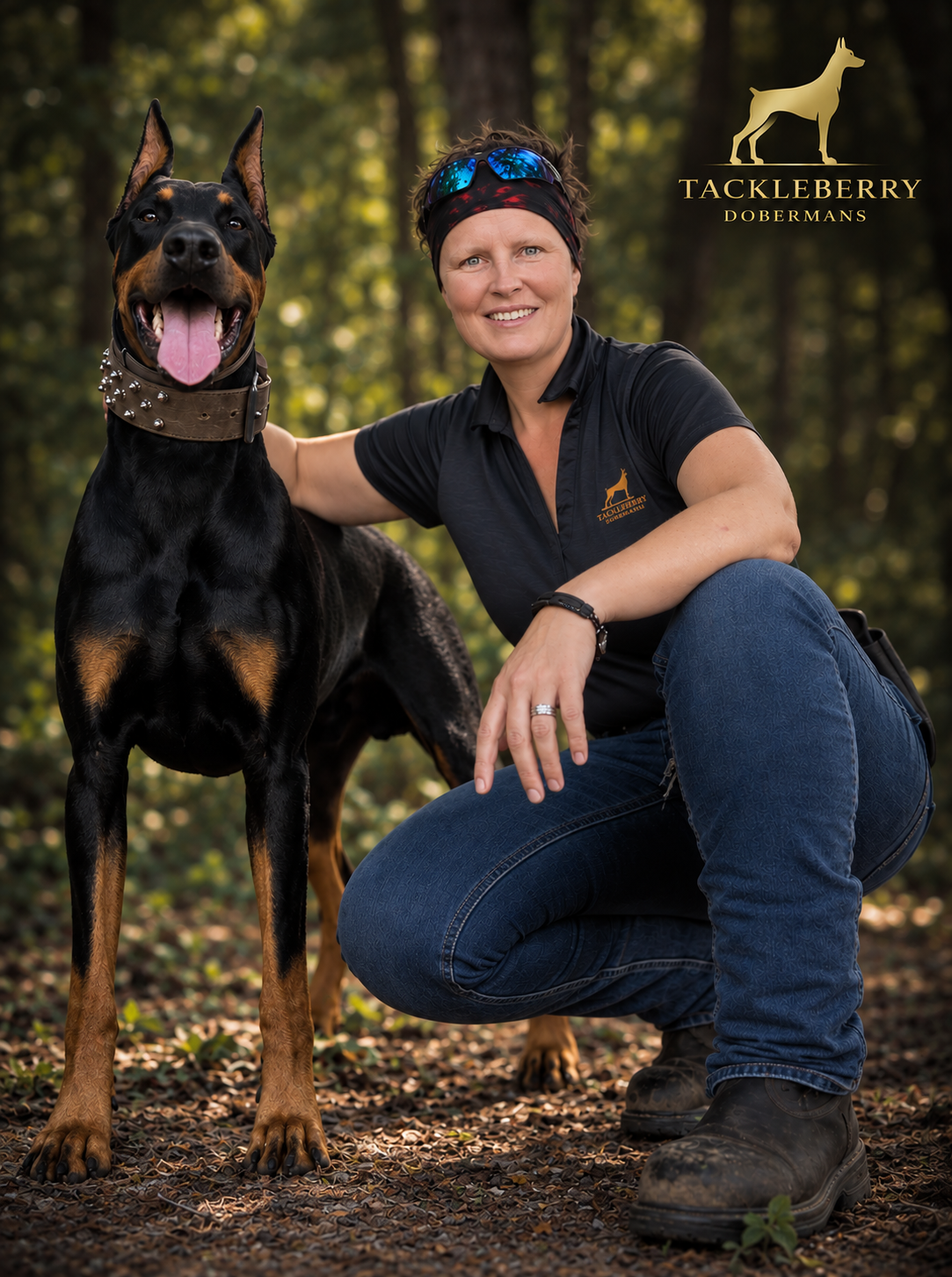
Hello, I'm Amy Arthur, founder of the Tackleberry Alliance.
My work within the K9 world is built around a simple belief: exceptional dogs deserve equally capable people beside them. Through education, development, and meaningful standards of achievement, I create practical frameworks that help you better understand the dog you're working with and discover what you're capable of accomplishing together.
Through my breeding program, the Tackleberry Alliance, and the Tackleberry Academy, you'll find the guidance, resources, and opportunities to take that partnership farther.
You bring the ambition. I'll help you build the path forward.
What Should You Expect From Professional Doberman Training?
Professional training is a significant investment. If you send your Doberman away for six weeks, you should expect meaningful results.
You should expect your dog to come home having learned something. You should expect to see progress. And if you watched your dog perform throughout the program, it is reasonable to expect that you will be able to experience those results yourself.
So when that doesn't happen immediately, the frustration can be significant.
You may wonder whether the training actually worked. Whether the progress you watched was dependent on the trainer. Whether you misunderstood what you were purchasing. Or, perhaps most frustrating of all, whether you spent thousands of dollars only to find yourself dealing with the same problems you expected professional training to solve.
Those are fair concerns.
And understanding why that gap can happen is important—not to excuse it, but to understand what professional Doberman training can realistically deliver and what has to happen for those results to successfully come home with the dog.
Doberman Instincts: Should You Trust What Your Dog Tells You?
A Doberman Is Not a Passive Participant in Training
Part of what makes the transition challenging is also part of what makes a well-developed Doberman such a valuable companion.
Dobermans are remarkably in tune with their handlers. They were bred to work closely with people and to be naturally attentive and protective of their families. They watch us, read us and learn our patterns—often more closely than we realize.
That relationship needs leadership. And with a Doberman, the difference between asking and telling can be surprisingly subtle.
A softer tone, an uncertain pause or repeating a command may feel patient and considerate to us. To a perceptive Doberman, those tiny differences can turn an expectation into a question:
Do you really mean stay? Is that boundary still there? Do I have to come the first time?
But the answer isn't to swing in the opposite direction.
Leadership isn't bullying. Excessive pressure can damage confidence and the relationship you're trying to build just as surely as unclear expectations can undermine obedience.
The balance is finer than many people realize: clear enough that your Doberman understands what is expected, fair enough that he remains confident in following you.
That is part of what makes transferring a professionally trained Doberman so important. You aren't simply learning which commands your dog knows. You're learning how to communicate those expectations with the clarity, consistency, and fairness this breed responds to.
You aren't simply bringing home a Doberman who has learned commands. You're taking over the leadership of a dog who has been learning how to follow them.
Board and Train Is About More Than Obedience
When people think about a Doberman board and train program, obedience is usually the easiest result to picture. Sit. Stay. Come. Heel. Place.
Those skills matter. But some of the most valuable development in a working dog can be harder to see on a checklist.
Confidence is one of them.
Whether you're developing a young puppy, guiding an adolescent through new challenges or working with an adult Doberman, confidence influences how that dog interprets and responds to the world.
New environments, unfamiliar surfaces, strange sounds, people, dogs and unexpected situations all create opportunities for a Doberman to learn whether something should be approached with curiosity, avoided with fear or handled calmly.
For puppies, that can mean carefully guiding them through important developmental and fear periods. For older dogs, it may mean strengthening confidence, expanding environmental experience or helping the dog develop better responses to situations that already challenge them.
Those experiences matter enormously in a breed valued for its protective qualities.
A Doberman cannot provide meaningful protective presence simply because he is suspicious, reactive or willing to bark. The stronger foundation is a dog that can enter an unfamiliar situation with confidence, remain engaged with the handler and recover appropriately when something challenges him.
Protection Dog Training: Should Your Dog Be Suspicious of Strangers?
That is why a well-designed board and train program can involve far more than teaching commands. It can include developing confidence, encouraging appropriate play and drive, building engagement, expanding environmental experience and teaching the dog to look to the handler for direction.
Some of those changes are dramatic. Others accumulate quietly.
But together, they help shape what the Doberman is capable of becoming.
Because much of that development happens gradually, it can be difficult to appreciate from a list of commands alone. Seeing the training unfold over time gives a much better picture of what those six weeks can actually include.
See an example: Watch a six-week Doberman training journey
What Should Six Weeks of Doberman Training Actually Accomplish?
Six weeks is a substantial amount of time. You should expect substantial progress.
What that progress looks like will depend on the dog's age, temperament, previous training and the goals of the program. But there should be a meaningful difference between the dog who entered training and the dog who comes home.
That difference may include stronger obedience, better impulse control, greater confidence, improved environmental stability, better engagement with the handler, more appropriate household behavior or development toward a specific working goal.
The important distinction is between a trained dog and a dog whose development is finished.
Your Doberman should come home knowing more, capable of more and better prepared for what you expect of him.
That training doesn't disappear when he leaves the trainer.
But the circumstances around it change.
New home. New routines. New expectations. And, most importantly, a different person holding the leash.
That's where transfer begins.
Six Weeks Is Only Half the Equation
A Doberman can make tremendous progress in six weeks—and still look very different when the leash changes hands.
That exposed a weakness in my own transfer process.
I prepared owners extensively for what to do. I wasn't spending enough time watching them do it.
Because you can understand the roadmap and still miss the smallest signals between you and your Doberman.
Does your command sound like an expectation—or a question? Are you being so gentle that the boundary becomes unclear? Are you trying so hard to establish authority that you're adding pressure your dog doesn't need? Do you expect your Doberman to follow through—or are you already anticipating that he won't?
Your dog is reading those differences even when you don't realize you're communicating them.
And that means a successful transfer requires more than knowing what to do. You need the opportunity to practice it, be observed, make adjustments and learn to recognize those subtle conversations for yourself.
Those differences can be almost invisible to us.
They aren't invisible to a Doberman.
That's where I'm raising the standard of my transfer process. A roadmap can explain the transition. But it can't watch the interaction happening in front of me.
Because six weeks can develop the dog.
The transfer has to prepare the person that dog will ultimately follow.
Your Doberman Knows It. But Will He Do It for You?
A professionally trained Doberman shouldn't come home requiring you to start over.
The training should be there.
But there is an important difference between teaching a dog a behavior and getting a dog who already knows that behavior to respond reliably to you.
That's where understanding your Doberman becomes valuable.
You don't need to become a professional dog trainer. You don't need hundreds of techniques. And you shouldn't have to recreate weeks of professional development yourself.
What you do need is enough understanding to communicate clearly, recognize when your Doberman is questioning an expectation, and know when he needs encouragement, clarity or follow-through.
Because the same Doberman who notices the slightest uncertainty in your command also notices your confidence. He learns your patterns. He learns what you expect. And he learns whether you mean what you say.
That isn't more training to pile onto your plate.
It's learning how to use the training you've already invested in.
And ultimately, that's where professional training becomes most valuable: not when your Doberman performs beautifully for the trainer, but when that training becomes part of the relationship between you and your dog.
The Better the Doberman, the Higher the Stakes
There is an interesting paradox in developing a Doberman for protection:
The more capability you build into the dog, the more valuable control becomes.
Confidence is valuable. Awareness is valuable. Protective instinct is valuable. A Doberman willing to notice something unusual and respond to it can be tremendously valuable.
But none of those qualities exist in isolation.
The ideal isn't a dog who needs permission to notice the world around him—or one who believes every decision is his to make.
The sweet spot is somewhere in between: a Doberman confident enough to notice, capable enough to respond, and connected enough to you that your direction still matters.
And that creates another consideration when investing in professional training.
More capability doesn't necessarily have to mean more dog to manage.
For some owners, the appeal of professional development is precisely that it can take their Doberman further than they could reasonably take him themselves.
That doesn't necessarily mean they want protection training to become a hobby, a specialty or another major demand on their time.
There is tremendous value in simply being able to benefit from the capability you've invested in.
Not by reproducing what a professional trainer can do, but by being able to live confidently with the results—to enjoy more of the protective value of your Doberman without taking on unnecessary complexity to maintain it.
That's where the DAD Academy can complement professional training.
You've already invested in developing a more capable Doberman. DAD is designed to help you get more from that investment—not ask more from you.
What Can't Six Weeks of Doberman Training Do?
This is where expectations matter.
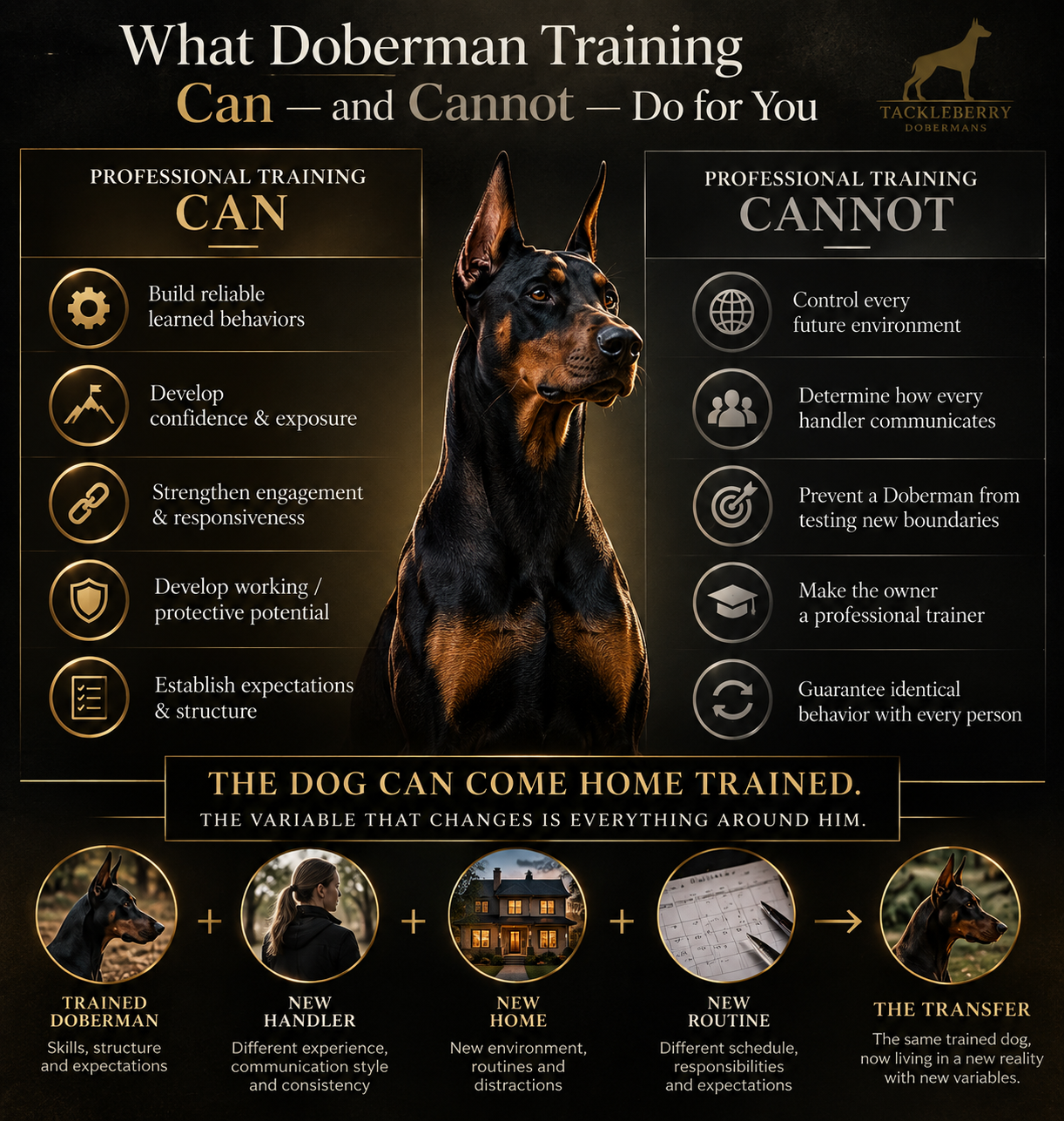
Professional training can build reliable learned behaviors. It can develop confidence and environmental experience. It can strengthen engagement and responsiveness, establish structure and expectations, and develop a Doberman toward specific working or protective goals.
But even excellent training cannot control everything that happens after your dog leaves.
It cannot make every home environment identical. It cannot determine how every person communicates with the dog. It cannot prevent an intelligent Doberman from discovering that boundaries may work differently with someone new. And it cannot guarantee that a dog will behave identically for every person in every situation.
That doesn't mean the training disappeared.
It means one of the most significant variables has changed.
The dog may be the same dog. The learned behaviors may still be there. But the person holding the leash, the environment surrounding him and the expectations being communicated are now different.
That's why I think the distinction matters so much:
Professional training can train your Doberman. It cannot make every future situation identical to training.
And you shouldn't have to become a professional trainer to bridge that gap.
The better answer is a transfer process that helps you recognize what is already there, understand how to access it and become comfortable leading the dog who is now living in your home.
The dog can come home trained. The transfer is what makes that training work in your life.
So perhaps the better question isn't what six weeks of professional training can accomplish. It's this: once that training comes home, how do you make the most of what your Doberman has learned?