
There’s an interesting contradiction in protection dog training.
We want a dog capable of recognizing when something isn’t right.
Then, sometimes, we deliberately limit his opportunity to learn what right looks like.
The reasoning can sound perfectly logical. If you want your dog to protect you, perhaps you shouldn’t encourage him to trust strangers. Maybe too much socialization will make him too friendly, too accepting, or less inclined to respond when someone actually poses a threat.
It’s a reasonable concern.
I just think it asks the wrong question.
Because you probably don’t want a protection dog who assumes every unfamiliar person is dangerous any more than you want one who assumes everyone is his newest best friend.
Wouldn’t you rather have a dog who can tell the difference?
And that ability starts developing much earlier than the moment anyone asks him to protect something.
Long before advanced training, controlled scenarios, or physical capability, a young dog is already doing something extraordinarily important:
He’s learning what the world is supposed to look like.
People. Sounds. Movement. Smells. Environments. Body language. Unexpected objects. Strange situations. The ordinary and the unusual are gradually becoming part of his understanding of the world around him.
Which raises a question that deserves considerably more attention in protection dog training:
If you want your dog to recognize when something is different, shouldn’t he first have enough experience to know what normal looks, sounds, smells, and feels like?
Further reading: Will My Doberman Protect Me?
Have we met?
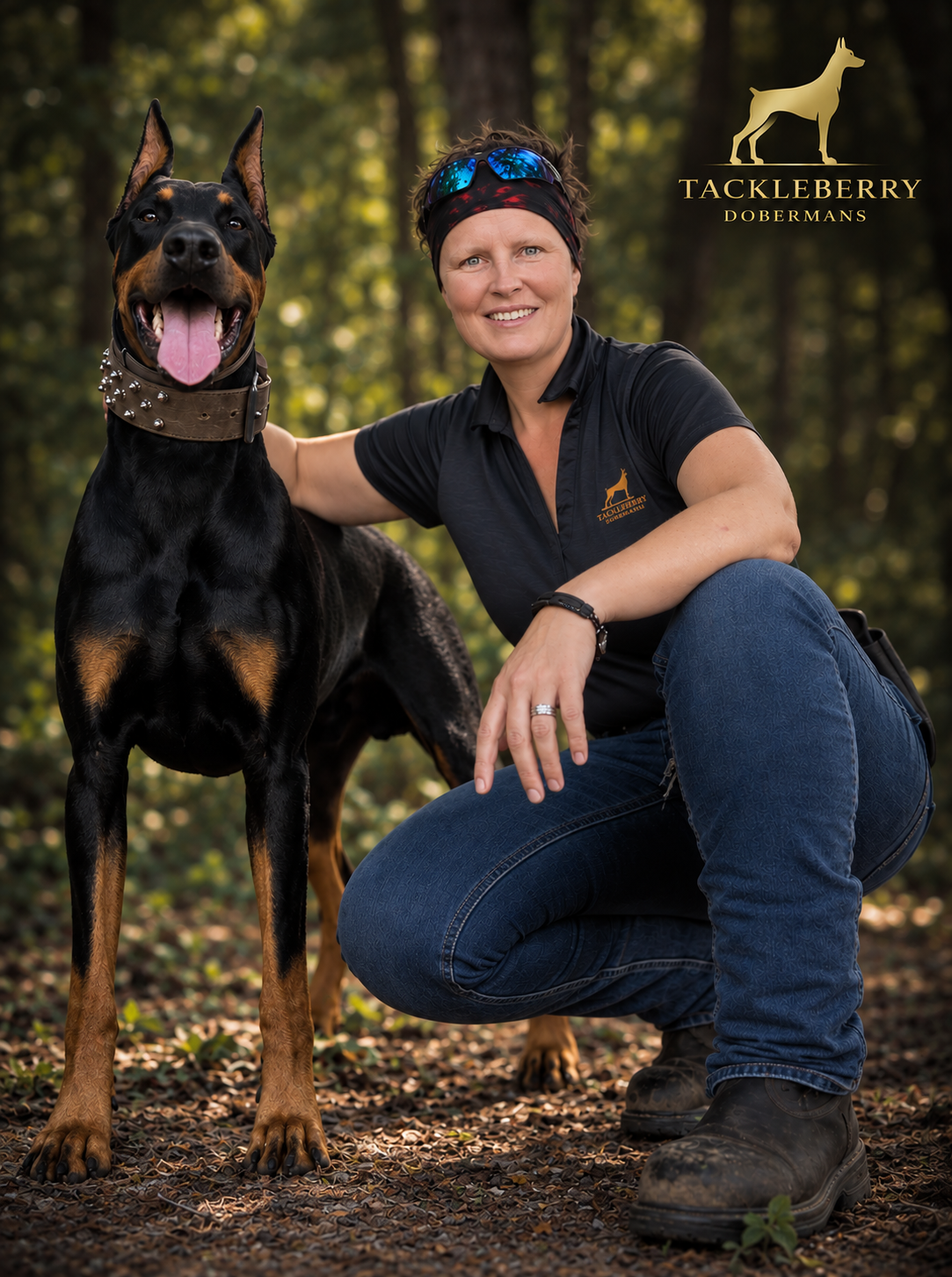
Hello, I'm Amy Arthur, founder of the Tackleberry Alliance.
My work within the K9 world is built around a simple belief: exceptional dogs deserve equally capable people beside them. Through education, development, and meaningful standards of achievement, I create practical frameworks that help you better understand the dog you're working with and discover what you're capable of accomplishing together.
Through my breeding program, the Tackleberry Alliance, and the Tackleberry Academy, you'll find the guidance, resources, and opportunities to take that partnership farther.
You bring the ambition. I'll help you build the path forward.
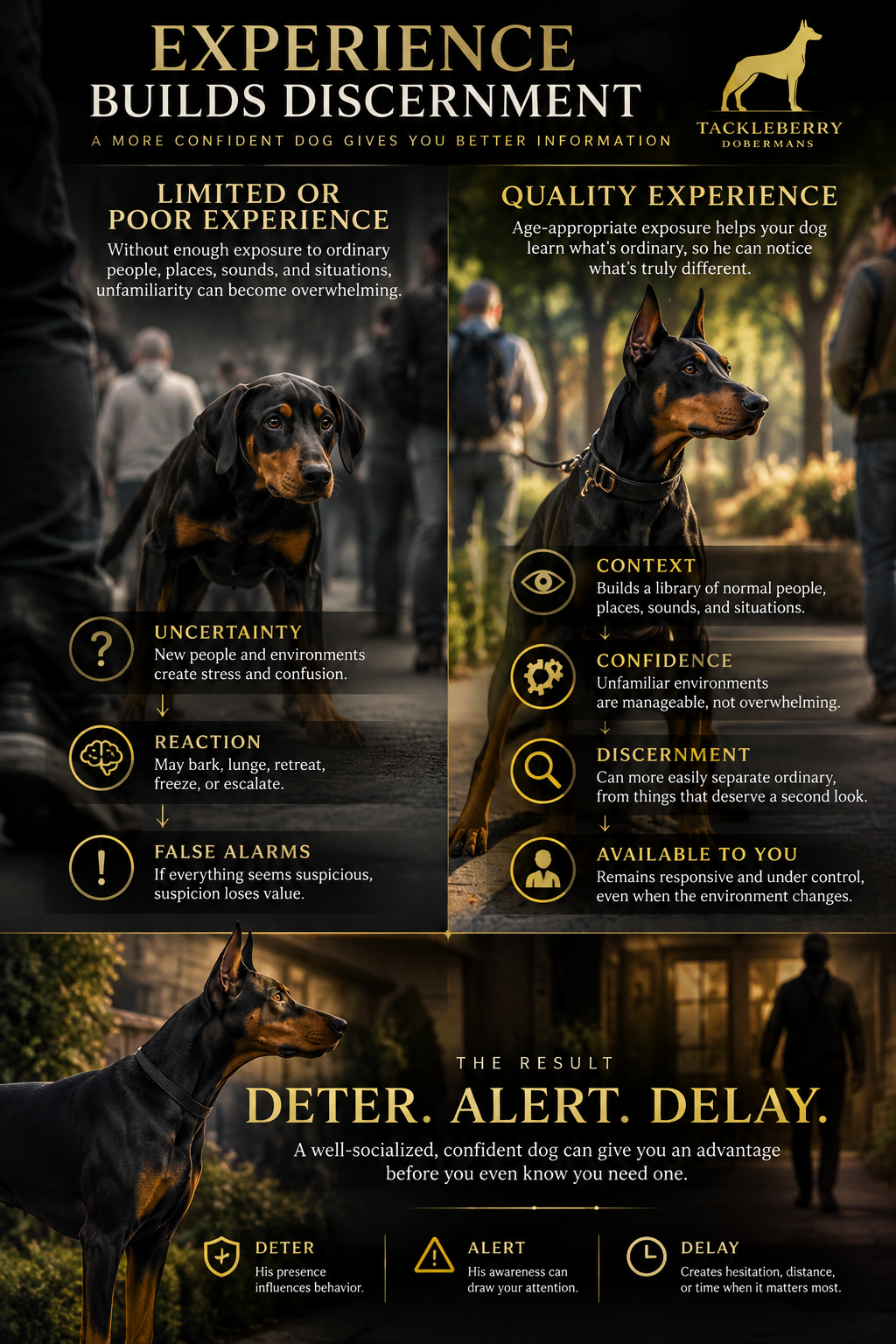
Your Dog Can’t Recognize “Different” Until He Knows “Normal”
Imagine walking into a room where you know absolutely no one.
You don’t know how these people normally speak, move, interact, or behave. Someone is pacing. Another person keeps glancing toward the door. A man in the corner is unusually quiet.
Does any of it mean something?
Maybe.
But without context, it’s difficult to know.
Further Reading: Your Protection Dog Isn't Your Bodyguard
A protection dog begins life with a similar problem. He isn’t born knowing that a child running toward him is ordinary, a delivery driver carrying a box is harmless, or a stranger moving differently deserves a second look.
Those reference points have to be built through experience.
Socialization helps create that library of “normal.”
Throughout development, experiences with different people, environments, sounds, movements, surfaces, smells, and situations give the dog more information to compare against what happens later.
The purpose isn’t to convince him that everything is safe. It’s to give him enough context that unfamiliarity itself doesn’t automatically become the most important thing in the room.
Because there is an important difference between:
“I’ve never seen this before.”
and
“I’ve seen enough of the world to notice that something about this is different.”
A man wearing a hood isn’t particularly interesting if the dog has encountered dozens of people wearing hoods.
Someone walking quickly isn’t necessarily interesting either.
Neither is a raised voice, unusual clothing, a person carrying an object, or someone approaching his handler.
Those things can all be perfectly ordinary.
But change the circumstances—the movement, proximity, attention, posture, tone, scent, behavior, or combination of signals—and suddenly the picture may deserve another look.
That’s why I don’t view socialization as simply teaching a protection dog to like people.
We’re giving him opportunities to learn about them.
And the more accurately a dog can place ordinary experiences into context, the more meaningful it becomes when something doesn’t quite fit.
Much of that foundation begins taking shape very early—long before a protection dog reaches maturity and, in many cases, before serious protection training ever begins.
Further Reading: Doberman Instincts: Should You Trust What Your Dog Tells You?
Protection Dog Training Should Start Building His Definition of the World Long Before He Protects You
A puppy’s brain isn’t simply a smaller version of an adult brain waiting to grow larger. It’s actively developing—building neural connections, processing sensory information, and learning which experiences deserve attention and how to respond to them.
Researchers describe sensitive periods: stages when the developing dog is particularly receptive to certain kinds of experience.
Genetics, temperament, breed, and later experiences still matter, but what happens during these periods can have an outsized influence on how the dog responds to similar experiences later.
The socialization period is one of the most important.
During this stage, the puppy is rapidly learning about people, dogs, environments, sounds, surfaces, movement, and the countless other pieces that make up ordinary life.
At the same time, something else is developing:
Fear.
To explain, very young puppies tend to investigate novelty relatively freely. As the nervous system matures, fear and avoidance responses begin to emerge, with meaningful differences between breeds, litters, and individual dogs.
This developmental process is behind what are commonly called fear periods.
They aren’t dates on a calendar when a puppy suddenly becomes afraid. They’re better understood as stages when the developing brain is changing how it interprets and responds to information.
Later development and adolescence bring additional neurological, hormonal, and behavioral changes. Something a dog previously accepted without hesitation may suddenly deserve a second look.
Likewise, the developing dog isn’t just experiencing the world. He’s learning how to interpret it.
Exposure Isn’t the Same Thing as Learning
That’s why simply exposing a young dog to something doesn’t tell us what he learned from it.
For example, dropping a puppy into an enormous crowd while he’s overwhelmed technically counts as exposure.
So does allowing him enough distance and time to observe something unfamiliar, investigate it, recover from uncertainty, and continue functioning.
Those experiences may teach very different lessons.
Above all, the objective isn’t simply to accumulate an impressive number of people, places, noises, and environments before some developmental clock runs out.
To clarify, a developing protection dog needs opportunities to encounter manageable novelty and discover something far more useful:
"I can experience something I don’t understand yet without allowing it to consume me."
Over time, those experiences can shape how a dog approaches novelty, recovers from surprise, solves problems, and stays functional when his environment changes.
So instead of asking:
“How much has this dog seen?”
the more interesting question may be:
“What has this dog learned to do when he sees something he doesn’t understand?”
For a dog you may eventually ask to remain clear-headed, responsive, and controllable when circumstances become uncertain, that distinction matters enormously.
Because uncertainty can produce something that, at first glance, looks surprisingly useful in a protection dog.
But is it?
Fear Can Look an Awful Lot Like Protection—Until It Doesn’t
A dog who barks, lunges, growls, or immediately becomes suspicious of unfamiliar people can certainly look protective.
Sometimes he may be.
But sometimes what you’re seeing isn’t confidence at all.
It’s fear moving forward instead of backward.
That’s an important distinction because fear doesn’t come with a predictable direction.
A fearful dog can certainly move toward a perceived threat. He can also retreat, freeze, attempt to escape, or escalate disproportionately.
Fear doesn’t promise retreat, and it doesn’t promise confrontation.
Even the same dog may respond differently when circumstances change.
That’s what makes fear such a gamble when we’re talking about protection.
In a study of nearly 6,000 dogs, inadequate puppyhood socialization was among the environmental factors associated with fear of unfamiliar people and dogs. Genetics and breed also influenced fearfulness, reminding us that development isn’t simply a product of socialization—but early experience was an important part of the picture. - See the study in Scientific Reports
And this is where suspicion can become misleading.
A dog who treats every unfamiliar person as potentially dangerous may appear highly vigilant. But if ordinary people, places, movements, and situations routinely produce uncertainty, you’re getting a lot of alarms without necessarily getting better information.
If everything is suspicious, suspicion stops being useful information.
Wouldn’t you rather have a dog who can encounter ordinary life without feeling the need to defend himself from it?
A dog who can notice something unusual without immediately losing his ability to think?
And if pressure does increase, wouldn’t you want as much of your dog’s mind available to you as possible?
Because ultimately, the question isn’t simply:
Will my dog react?
It’s:
What happens to his judgment—and my ability to influence him—when he does?
And perhaps even more importantly:
When my dog notices something unusual, is he processing information—or simply reacting to uncertainty?
That difference becomes even more interesting when you look at what socialization may influence beyond whether a dog simply likes strangers.
Socialization for Protection Dog Training Changes More Than Sociability
If socialization only determined whether your dog enjoyed meeting strangers, it wouldn’t be nearly as interesting to protection dog training.
Its potential value goes much further.
Think about the dog you’d want beside you when the environment becomes unfamiliar or something unexpected happens.
The potential impact reaches into things like:
Those aren’t merely social skills.
In fact, they’re qualities that can influence how useful your protection dog’s training becomes when you actually need it.
Furthermore, research supports some of these possibilities.
To elaborate, in a controlled study of 83 puppies, researchers gave some puppies additional age-appropriate novelty, problem-solving challenges, and sensory experiences. At six to seven weeks, those puppies startled less, recovered more quickly from a startling noise, approached novel objects more boldly, solved an unfamiliar problem faster, and persisted longer while attempting it.
And then there’s the quality that may matter most.
A dog who still has attention available for you.
Training doesn’t happen in a vacuum.
A protection dog may understand exactly what you want in the familiar environment where he learned it. Change the people, sounds, smells, surroundings, and pressure, however, and suddenly his brain has two jobs:
Process everything unfamiliar around him—and remain available to you.
That’s another reason socialization matters to protection dog training.
You’re giving him practice experiencing the world without allowing the world to consume all of his attention.
Because what good is exceptional training if, the moment the environment becomes complicated, it gets more of your dog’s attention than you do?
More Socialization Isn’t Necessarily Better Socialization
There’s a reason some people in the protection world are cautious about socialization.
What if you make the dog too friendly?
If your protection dog learns that every stranger is wonderful, every new person deserves affection, and everyone who approaches you is an opportunity to make a new friend, have you accidentally socialized away some of the very qualities you wanted?
It’s a reasonable concern.
And it can appear to create an uncomfortable choice.
You could limit your dog’s exposure to strangers in an attempt to preserve suspicion—but potentially sacrifice some of the experience that helps him become confident and comfortable navigating the world.
Or you could expose him to absolutely everyone and everything in the name of “socialization”—and potentially teach him that the entire world exists for his entertainment.
Neither is what we’re trying to build.
The problem isn’t necessarily too much socialization.
It’s what your dog is learning from it.
A hundred strangers enthusiastically petting your dog aren’t necessarily more valuable than one unfamiliar person your dog has enough time and space to observe, investigate, and understand.
Walking through a crowded festival isn’t automatically valuable because there were more people, sounds, smells, and distractions. If your dog spent the entire experience overwhelmed, what exactly did all that exposure teach him?
That’s where the definition of socialization starts to change.
It’s to teach him how to encounter things he hasn’t seen before.
Sometimes that means interaction.
Other times it means observation.
Then perhaps the most valuable thing your dog can learn about a stranger is that the stranger doesn’t matter at all.
Because now the question isn’t simply where you take your dog.
It’s what he’s learning while he’s there.
Which brings us to a more interesting question:
What exactly should you develop?
The Goal Was Never a Friendly Protection Dog
Not friendliness.
Discernment.
A well-socialized protection dog doesn’t need to love everyone he meets. He doesn’t even need to be particularly interested in them.
Wouldn’t you rather have a dog capable of moving confidently through ordinary life without feeling compelled to either befriend everything or challenge everything?
That middle ground is remarkably valuable.
First, the stranger walking past you can be irrelevant.
Likewise, the waiter approaching your table can be ordinary.
Moreover, the person standing unusually close might deserve more attention.
And when something about the environment genuinely changes, wouldn’t you want your dog capable of noticing that change without immediately deciding for himself what should happen next?
That’s where socialization begins serving a much larger purpose.
Experience gives the dog context. Ordinary becomes ordinary. Novelty becomes something he knows how to process. And unusual behavior has a larger library of experience against which to stand out.
Indeed, the value is a dog that can experience the world, process what is happening around him, and stay available to you while he does it.
Because recognizing that something is different is valuable.
But it’s still only information.
What happens next depends on something much bigger than the dog.
Recognizing “Different” Is Only the Beginning with Protection Dog Training
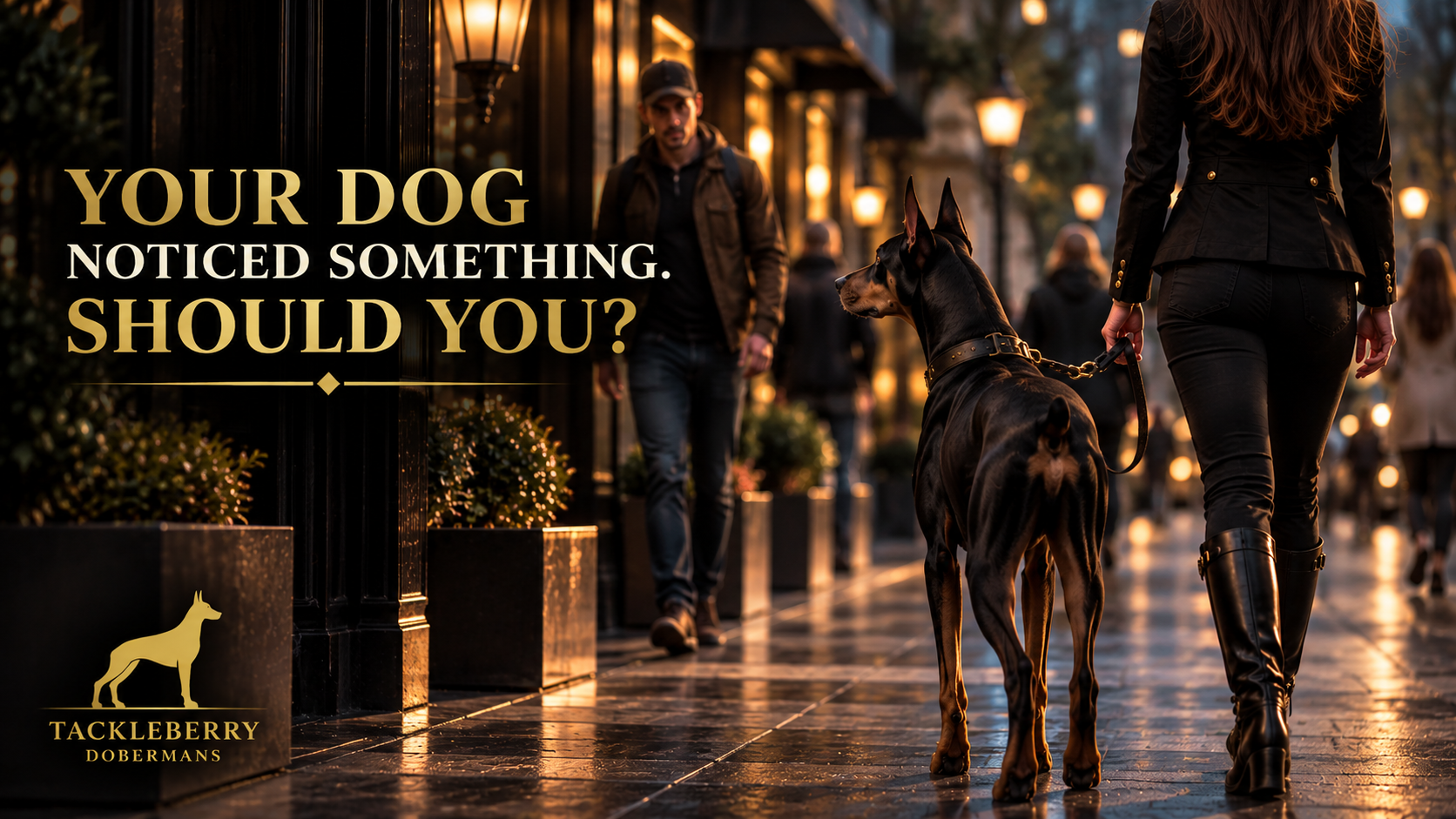
Imagine your dog suddenly stops and looks toward someone approaching you.
Maybe it was the person’s movement. Their proximity. Their attention. A change in tone or posture. Perhaps it was something you hadn’t noticed at all.
That’s useful information.
But information isn’t a decision.
What happens next shouldn’t depend entirely on what your dog decides to do with it.
Your dog has access to information you don’t.
You have access to information he doesn’t.
He may detect subtle changes in scent, movement, sound, or behavior before you consciously recognize them. You can interpret context, understand circumstances, and make decisions your dog simply cannot.
Neither half of that equation is as capable alone as the two can become together.
That changes the question from:
“Can my dog recognize when something is different?”
to:
“What can we do with that information together?”
Consider the difference.
Your dog suddenly becomes intensely interested in a man walking toward you.
If your dog has had very little experience with unfamiliar people, what does that interest actually tell you?
Context Makes A Difference
Is something unusual about the man—or is your dog reacting because he’s wearing a hat, walking differently, carrying a bag, or simply happens to be someone he hasn’t seen before?
You don’t have much context for interpreting the signal because neither does your dog.
Now imagine a dog who has calmly experienced hundreds of ordinary variations of people, movement, clothing, environments, and interactions.
Most of them no longer deserve much attention.
Then one day, he notices someone.
You still don’t automatically assume that person is a threat. Your dog isn’t infallible, and interest isn’t proof of danger.
But wouldn’t that change how much attention you give to what your dog is telling you?
The more clearly your dog understands “ordinary,” the more meaningful “different” can become.
And the better you understand your dog, the easier it becomes to distinguish curiosity, uncertainty, excitement, fear, and behavior that genuinely deserves more of your attention.
Now confidence, discernment, communication, control, and capability begin fitting into a much larger system.
Deter. Alert. Delay. — What You Do With the Information Matters
More: What is a DAD Doberman?
This is where socialization begins connecting to something much larger.
A dog who understands more of the world around him has more context for recognizing when something changes. And when you understand your dog well enough to recognize what he’s telling you, that information can become useful.
This is one of the ideas behind Deter. Alert. Delay.
A capable protection dog can influence a situation long before physical engagement ever becomes necessary.
His presence can Deter.
His awareness can Alert you to something you haven’t recognized yet.
And the time, distance, hesitation, or disruption he creates can Delay what happens next—giving you something remarkably valuable:
Time to make a decision.
Further Reading: What Is the DAD Standard?
Your Dog May Be Capable of Giving You More Than You Realize
Most people think about protection dog training in terms of what the dog can be taught to do.
Obedience. Alerting. Deterrence. Physical protection.
But there’s another side of the relationship that’s much easier to overlook:
A protection dog can give you an advantage before you even know you need one.
And through all of it, remain under your control rather than becoming another variable you have to manage.
That’s considerably more useful than simply owning a dog capable of winning a confrontation.
It’s a dog whose capability can begin working in your favor much earlier.
That is the advantage behind Deter. Alert. Delay.
And there are two very different ways to put it to work.